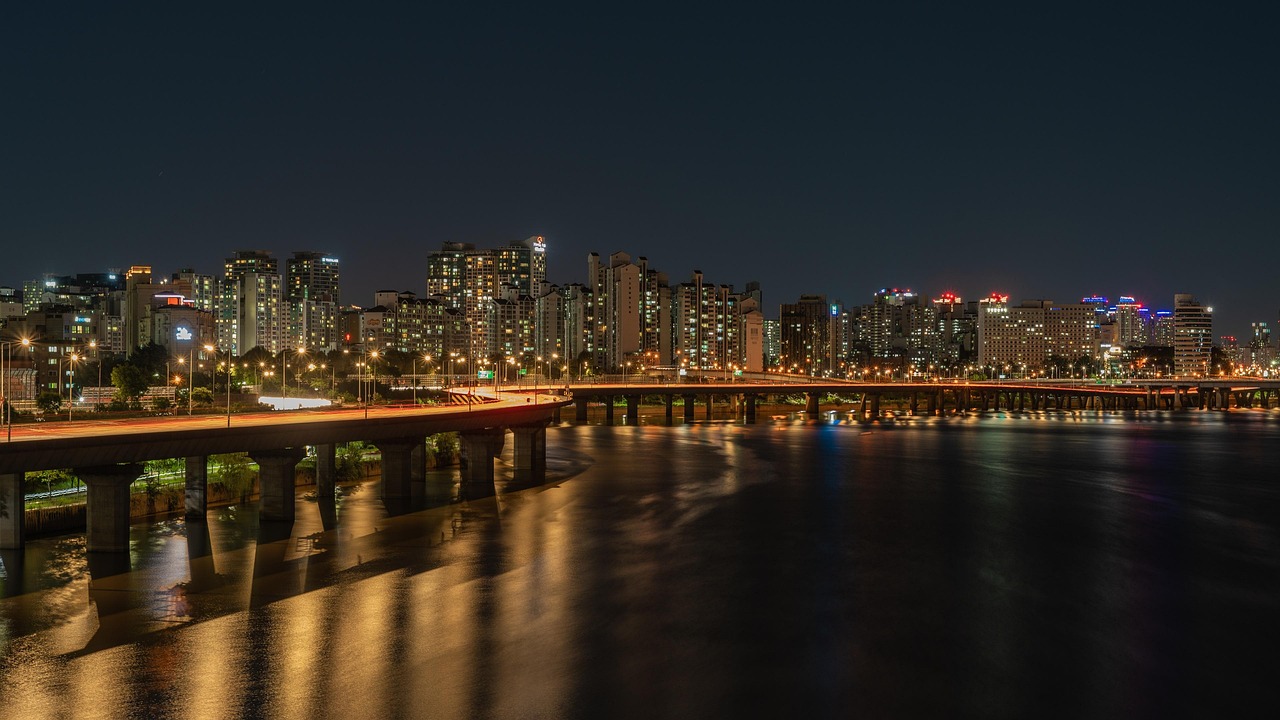
By eight in the evening in early August, the pavement outside Seoul City Hall finally stops radiating heat, and thousands of people who spent the afternoon hiding in air-conditioned coffee shops or department store basements start drifting toward the river. Inflatable movie screens bob on the water at Nanji Hangang Park. String lights flicker on above rows of picnic mats. Somewhere near Yeouido a delivery rider weaves through the crowd balancing four boxes of fried chicken on one arm. This is Seoul’s real summer schedule — not the daytime sightseeing loop most first-time visitors plan around, but a city that quietly rearranges itself after sunset, when the heat drops from unbearable to merely warm.
July and August in Seoul mean daytime temperatures regularly above 33°C with humidity that makes it feel worse, punctuated by sudden monsoon downpours (jangma season typically runs into mid-July, though the exact end date shifts year to year — confirm current conditions before you travel). Locals have built an entire seasonal culture around dodging the worst of it: indoor mornings, air-conditioned middays, and river-and-night-market evenings. The city’s own summer festival calendar is built around that same rhythm, and knowing it changes how you should plan a July or August trip.
The Hangang River Festival: What’s Actually On This Summer
The centrepiece of Seoul’s official summer calendar is the Han River Festival Summer edition, scheduled for August 1–16, 2026 under the theme “Passionate Vacation with Cool, Cheap Activities” — dates and programming can shift, so confirm on the official festival.seoul.go.kr/hangang site before you build a schedule around it. The Seoul Metropolitan Government runs around 18 separate leisure programs across the river parks during this window, and most of them are free or low-cost, which is unusual for a festival of this scale.
- Hangang Cinema Splash — outdoor film screenings watched from inflatable floats on the water at Nanji Hangang Park, a genuinely odd and photogenic way to see a movie that you will not find replicated elsewhere in the city
- Hangang Summer Music Picnic — candlelit night concerts at Yanghwa Hangang Park, low-key enough that you can arrive without a ticket and just find a spot on the grass
- Under the Bridge Film Festival — free outdoor cinema running under the bridges at Ttukseom, Gwangnaru and Yeouido Hangang Parks, the most low-commitment of the three if you just want to wander in for an hour
- Golden Blue Marina yacht tours — short paid trips (Day, Sunset, Night View and Fountain Show routes) departing from the marina near Yeouido, the closest thing to a boat cruise most visitors will find on the Han River
None of these require the kind of advance planning that, say, a DMZ tour does. Programming and exact showtimes are published closer to each date on the festival’s official page, so treat everything above as a shortlist to check on arrival rather than a fixed itinerary — verify on the official site before visiting.
Cinema Splash vs Under the Bridge: Which Night Screening Suits You
If you only have one evening free for a river film night, the choice usually comes down to these two. Cinema Splash is the novelty pick — you are watching a film from a floating platform, which makes for better photos and a better story, but it is a single-location event at Nanji Hangang Park, which sits further from central Seoul than the other river parks, and float capacity is limited on busy nights. Under the Bridge Film Festival is the practical pick: it runs across three separate parks (Ttukseom, Gwangnaru, Yeouido), so there is almost always one within reach of wherever you are staying, it is free lawn seating with no capacity gimmick, and it suits families or anyone who wants to leave early without feeling like they wasted a booking. First-timers short on time should default to Under the Bridge; repeat visitors or anyone chasing a specific photo should make the trip to Nanji for Cinema Splash.
Day vs Night: Building a Seoul Summer Schedule Around the Heat
The single biggest planning mistake visitors make in July and August is scheduling outdoor sightseeing — palace grounds, Bukchon’s hillside alleys, long park walks — for the early afternoon, exactly when the heat and humidity peak. Locals invert this. Mornings before 10am are for anything outdoors, since temperatures are still tolerable and crowds are thinner. Midday, roughly 12pm to 4pm, shifts indoors by default: department stores, museums, underground shopping arcades, cafes with strong air-conditioning. Evenings, from around 6pm onward, are when the city properly comes back outside, and that is when the river festival programming, night markets and street life peak.
This matters for the Han River Festival specifically: almost every marquee event listed above — the film screenings, the candlelight concerts, the sunset and night yacht tours — is scheduled for evening or after dark, which lines up neatly with when it is actually pleasant to be outside. If you try to visit the river parks at 2pm expecting festival energy, you will mostly find locked-down grass and a handful of joggers.
Where to Cool Off Between Events
Between the morning sights and the evening river programme, most visitors need somewhere to reset for a few hours. Large department stores (Lotte, Shinsegae, and the mall complexes around COEX and Gangnam) function as de facto public cooling centres — nobody minds if you sit in the basement food hall for an hour with an iced coffee. Cheonggyecheon, the restored stream running through downtown, is a couple of degrees cooler than the surrounding streets thanks to the water and sunken walkway, and makes for a pleasant early-evening walk before heading toward the river; it also happens to be one of the better free options if you are trying to stretch a budget — see our roundup of free things to do in Seoul for more in the same vein.
A local habit worth borrowing: convenience stores (CU, GS25, 7-Eleven) sell cup bingsu (shaved ice dessert) and frozen drinks that are markedly cheaper than a cafe version, and many locations mark down perishable desserts late in the evening — it is a five-minute, low-cost way to cool down between sights that does not show up in most official tourism guides. Pairing a river festival evening with a convenience-store bingsu stop beforehand is a fairly standard Seoul summer move, not something aimed at tourists.
Getting to the Han River Parks: Which Station for Which Zone
The river parks hosting festival programming are spread along a wide stretch of the Han, and picking the wrong station adds a lot of walking in the heat, so it is worth checking before you set out.
- Yeouido Hangang Park (Under the Bridge screenings, near Golden Blue Marina) — Yeouinaru Station, Line 5, Exit 2, about a 5-minute walk to the riverbank
- Ttukseom Hangang Park (Under the Bridge screenings) — Ttukseom Hangang Park Station, Line 7, Exit 2, roughly a 10-minute walk
- Gwangnaru Hangang Park (Under the Bridge screenings) — Gwangnaru Station, Line 5, then around a 15-minute walk or a short local bus
- Nanji Hangang Park (Cinema Splash) — the furthest out; Digital Media City Station (Lines 6/Gyeongui-Jungang/Airport Railroad) followed by a local bus or a 20–25 minute walk is the usual route
- Yanghwa Hangang Park (Music Picnic concerts) — Hongik University Station or Mangwon Station, both roughly a 10–15 minute walk
Standard Seoul subway fare applies to all of these (a single T-money card ride is roughly ₩1,400–1,500 as of 2026 — verify on the official site before visiting, since fares are adjusted periodically). None of the river parks are directly served by an exit that drops you at the festival zone, so budget extra walking time in the heat, and carry water — shaded seating is limited along most of the riverbank.
Beyond the River: Fountains, Yachts and Slotting Summer Into a Trip
The Han River Festival is not the only warm-weather draw. Banpo Bridge’s Moonlight Rainbow Fountain — coloured fountain jets that shoot out from the bridge itself, lit up after dark — typically runs from spring through autumn, but exact show times vary by month and season and are not fixed, so confirm the current schedule on the official site before visiting rather than planning a whole evening around a specific slot. It is walkable from Express Bus Terminal Station and pairs well with a river walk on the same night as a festival screening if you are staying in the southern half of the city.
For visitors trying to fit summer events into a short trip, the honest advice is to treat the river festival as one evening slot rather than a full day out — it works well tucked into an existing Seoul itinerary on whichever night you are already staying near the river, rather than a special trip built entirely around it. Pair a late afternoon at a department store or Cheonggyecheon with an evening screening or concert, and you get the full day-to-night rhythm that the festival is actually designed around, without wasting a full day waiting for the sun to go down.
Who this suits: travellers who like flexible, low-commitment evening plans and do not mind checking a schedule the day of. Who it does not suit: anyone wanting a guaranteed, ticketed experience booked weeks in advance — most of this programming is announced and adjusted close to the date, and treating it as a firm plan rather than a shortlist is the most common way visitors end up disappointed.
When exactly is the Han River Festival in summer 2026?
The Hangang River Festival Summer edition is scheduled for August 1–16, 2026, but programming and exact event dates within that window can shift — confirm current details on festival.seoul.go.kr/hangang before visiting.
Is the Han River Festival free to attend?
Most of the core programming — the outdoor film screenings and the candlelight concerts — is free. Paid extras like the Golden Blue Marina yacht tours are separate bookings; prices and availability change, so check the official site before visiting.
What happens to outdoor screenings if it rains?
Seoul’s summer often includes sudden downpours. Outdoor film events and concerts are typically postponed or cancelled in heavy rain rather than moved indoors, so check the festival’s official page or social channels on the day if the forecast looks unstable.
Do I need to book the Han River yacht tours in advance?
Sunset and night tours from Golden Blue Marina are popular in summer and can fill up on weekends, so booking a day or two ahead is safer than turning up on the spot, particularly in the August 1–16 festival window — confirm current booking rules on the official site.
Is Seoul walkable in July and August heat?
It is manageable if you shift outdoor plans to morning and evening and use department stores, malls or Cheonggyecheon to cool off midday. Humidity above 33°C in the early afternoon makes extended walking uncomfortable, so build in air-conditioned breaks rather than pushing through a full daytime itinerary.