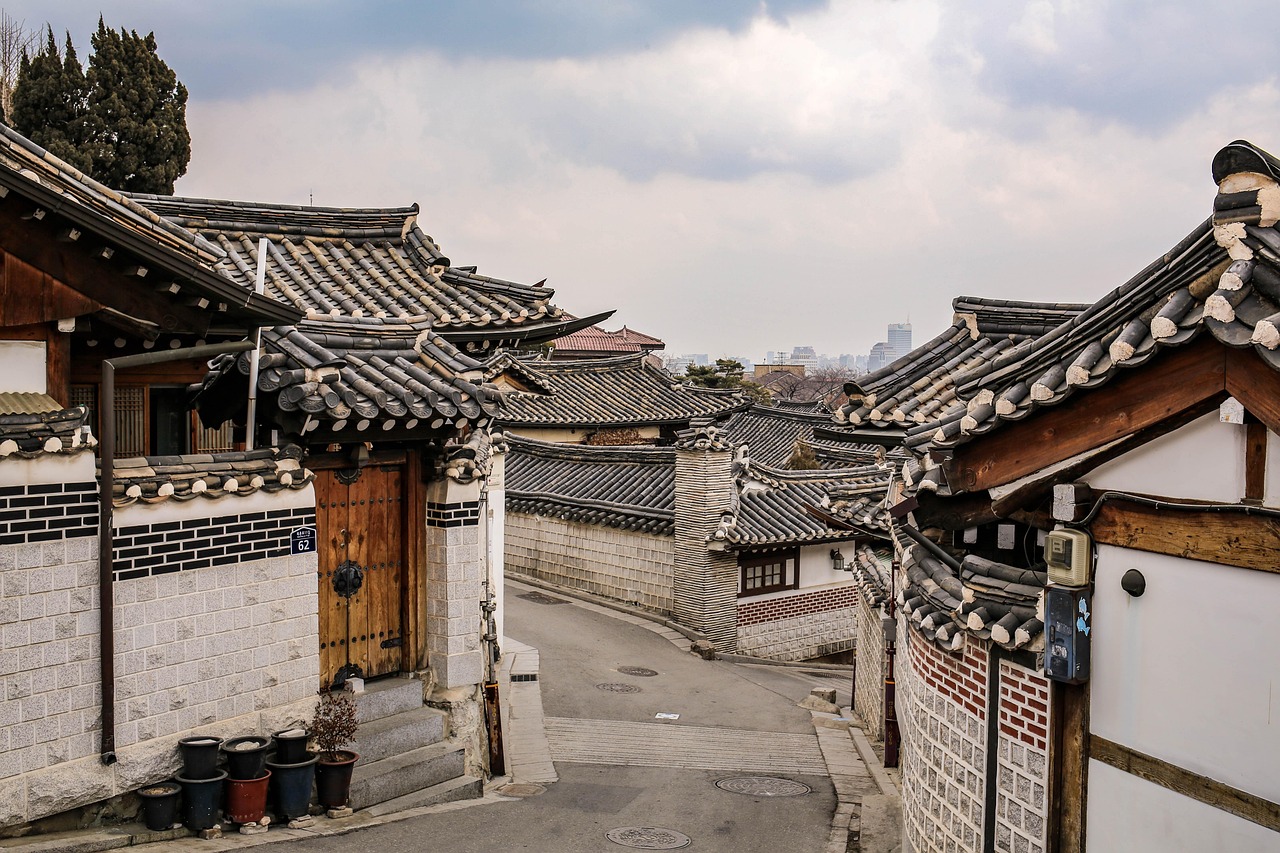
The photograph from Bukchon Viewpoint No. 2 — a long descending alley of curved grey tile rooftops with Namsan Tower rising in the haze behind them — is probably the single most reproduced image of Seoul. It has appeared in millions of travel feeds, K-drama promotional materials, and tourism campaigns. What most of those images do not show is the sign at the top of the alley warning visitors that this neighbourhood has strict rules, and that breaking them now carries a real fine. Getting that shot in 2026 requires knowing what changed — and what you owe to the people who actually live here.
What Bukchon Hanok Village Actually Is
Bukchon — meaning “northern village” — is a residential hillside neighbourhood wedged between two of Seoul’s great royal palaces: Gyeongbokgung to the west and Changdeokgung to the east. The name refers loosely to the area of Gahoe-dong and Samcheong-dong where roughly 900 traditional hanok houses survive largely intact, most dating to the early twentieth century. Unlike open-air museum reconstructions, these are private homes. Families live, sleep, and work inside them. The tile-roofed silhouette you admire through a camera lens is someone’s front door. That distinction is not just philosophical — it is now enforceable law. For context on the surrounding area, the Gyeongbokgung palace guide covers the palace directly to the west, and the Insadong guide covers the craft-and-tea street just minutes away on foot.
2026 Visiting Rules — Curfews, Fines and Photography
Bukchon introduced its most significant visitor restrictions in 2026, and most older guides have not caught up. If you are planning a visit based on information from 2024 or earlier, read this section carefully before you go.
Red Zone hours: The densely residential core of Bukchon — the alleys that contain the famous viewpoints — is now a designated Red Zone with strictly enforced visiting hours of 10:00 to 17:00 only. Entering these restricted areas outside those hours carries a fine of ₩100,000. There are no exceptions for “just a quick look” or arriving slightly early for a sunrise shot. Rangers and signage make the boundary clear.
Chartered buses banned: From January 1, 2026, chartered tour buses are banned from entering the neighbourhood. Any chartered bus operator found in the restricted zone faces a fine of ₩300,000. If your group is arriving by organised coach, confirm with your tour operator that they will drop you at the perimeter — not inside.
Group size limit: Groups are capped at a maximum of 10 people together in the alleys. Larger groups should split before entering and meet elsewhere afterward.
Noise rules: The neighbourhood enforces quiet zone rules. Keep voices low. No loudspeakers, no amplified music, no shouting between members of your group. Residents have formally complained for years about noise disrupting daily life; the rules now have teeth.
Photography rules: You may photograph the streetscapes, rooflines, and alleys freely within visiting hours. You may NOT photograph through windows, doorways, or open gates into private residences. No flash photography anywhere in the alleys. Aim your lens at the architecture and the skyline — not at the people living inside.
What to See and the 8 Scenic Viewpoints
The official Bukchon 8 Gyung system — eight numbered scenic viewpoints mapped and signposted throughout the neighbourhood — gives structure to what could otherwise be a confusing uphill maze. Each viewpoint captures a different character of the village.
Viewpoint 2 is the essential one. It sits at the top of Gahoe-dong’s main alley and looks south down a dense corridor of tile rooftops toward the city and Namsan Tower. This is the photograph. Arrive right at 10:00 on a weekday to have any chance of a clean shot; by mid-morning on weekends, 30 or more people may be lined up at the same narrow spot.
The other viewpoints reward slower exploration. Viewpoints 1 and 3 offer elevated angles looking across the rooflines toward Bugaksan mountain. Viewpoints 4 through 6 are quieter and draw fewer crowds, giving a more honest sense of what it is like to walk through a genuinely inhabited traditional neighbourhood. Viewpoints 7 and 8 near the Samcheong-dong edge transition toward the gallery street and its coffee shops, and the atmosphere becomes more commercial.
Beyond the viewpoints, the neighbourhood’s value is in the texture of the alleys themselves — the sound of a gate closing, a cat sleeping on a stone wall, the smell of cooking from behind a wooden door. Resist the pressure to rush between numbered signs and instead walk slowly without a fixed route.
Getting There and Navigating the Uphill Terrain
Take subway Line 3 (the orange line) to Anguk Station and use Exit 2. From the exit, the main alleys of Bukchon are roughly a 10-minute walk uphill. The terrain is genuinely steep — not a gentle slope but a sustained climb on narrow stone-paved lanes. Wear proper shoes with grip. Flip-flops and dress shoes will cause problems on wet days, and the lanes can be slippery in rain or frost.
There is no car access that simplifies the approach. Taxis can drop you on the main road at the base, but you will walk the hill regardless. The uphill effort is part of the experience — the neighbourhood sits on a ridge, and the views exist because of the elevation. For broader guidance on moving around the city, the Seoul subway guide covers Line 3 and all other lines in detail.
Note that Jogyesa Temple (Line 3, same Anguk Station) and the Insadong alley are both within easy walking distance, making it logical to combine all three in a single morning without retracing your route.
The Right Way to Spend Time Here
The most straightforward mistake tourists make in Bukchon is treating it as a photography location to be processed quickly. The neighbourhood rewards a slower approach — arriving at 10:00, walking without a set agenda, and allowing time to sit somewhere before the crowds arrive.
Cha-Teul is a traditional tea house operating inside a renovated hanok with views of the mountain behind the neighbourhood. It serves traditional Korean teas — barley, chrysanthemum, citrus — in a setting that is genuinely quiet and without the performance of most tourist-facing cafes. It is a good place to decompress after the viewpoint crowds and understand what hanok architecture feels like from the inside rather than through a lens.
The residential character of Bukchon means you are a guest in someone else’s neighbourhood. Gates that are open are not invitations. Residents who are visible outside deserve the same distance you would want from strangers on your own street. The rules are not arbitrary inconveniences — they are the result of years of residents petitioning against noise, intrusion, and loss of privacy in a place where people are trying to live normally.
If you are wearing hanbok, you will receive free entry to all four major palaces — Gyeongbokgung, Changdeokgung, Deoksugung, and Changgyeonggung — which pairs well with a Bukchon visit. The hanbok guide explains where to rent and what to expect.
Best Times to Visit
Weekday mornings are the clear answer. Arrive at Anguk Station before 09:45 and be at the top of Viewpoint 2’s alley when the Red Zone opens at 10:00. In the first hour, the crowds are manageable and the light from the east catches the tile rooftops well.
Spring (late March to early May) and autumn (October to early November) are the best seasons. Spring brings clear skies and moderate temperatures that make the uphill walk comfortable. Autumn adds the colour of the trees surrounding the neighbourhood and on the palace grounds nearby. Both seasons coincide with peak tourism, so weekday mornings matter even more.
Weekends are frustrating for anyone hoping to photograph the alleys without crowds. The narrow lanes fill quickly, and the queues at Viewpoint 2 can stretch back far enough that the viewpoint itself is blocked. Weekend afternoons in summer are the worst possible combination: heat, crowds, and a 17:00 curfew that compresses everyone into a short window.
Winter is an underrated option. December through February sees significantly fewer visitors, and light snowfall on the tile rooftops produces a genuinely different version of Bukchon that the standard photographs do not show. The cold is real — the hilltop location catches wind — but the quiet is worth it.
Bukchon sits naturally within a broader Seoul itinerary centred on the northern palace district. For a structured approach to your first days in the city, the first three days in Seoul guide sequences Bukchon alongside Gyeongbokgung and Insadong in a way that minimises backtracking. The five-day Seoul itinerary adds Changdeokgung’s Secret Garden — bookable separately — and the surrounding neighbourhood on a longer timeline.
Is Bukchon Hanok Village free to enter?
Yes, entry to Bukchon Hanok Village is free. However, the Red Zone residential alleys — including the famous viewpoints — are only open from 10:00 to 17:00, and entering outside those hours carries a ₩100,000 fine. The surrounding streets and the Samcheong-dong area adjacent to Bukchon have no access restrictions.
What are the visiting hours for Bukchon Hanok Village in 2026?
The restricted Red Zone core of Bukchon — covering the main residential alleys and the 8 scenic viewpoints — is open strictly from 10:00 to 17:00 daily as of 2026. These hours apply every day including weekends and public holidays. Check for any updates to these rules before visiting, as enforcement is ongoing and hours may be refined.
Is it okay to take photos at Bukchon Hanok Village?
Photography of the streetscapes, rooflines, and alley views is permitted within visiting hours. You may not photograph through windows, doorways, or open gates into private residences, and flash photography is not allowed anywhere in the alleys. The famous shot at Viewpoint 2 — the long alley looking toward Namsan Tower — is fully accessible, but aim at the architecture rather than at residents.
How long should I spend at Bukchon Hanok Village?
Allow 1.5 to 2.5 hours for a thorough visit covering the main viewpoints and some of the quieter side alleys. If you plan to stop at Cha-Teul tea house or walk down to Samcheong-dong afterward, budget 3 hours total. The neighbourhood works well as a morning activity combined with Gyeongbokgung Palace or Insadong in the same half-day.