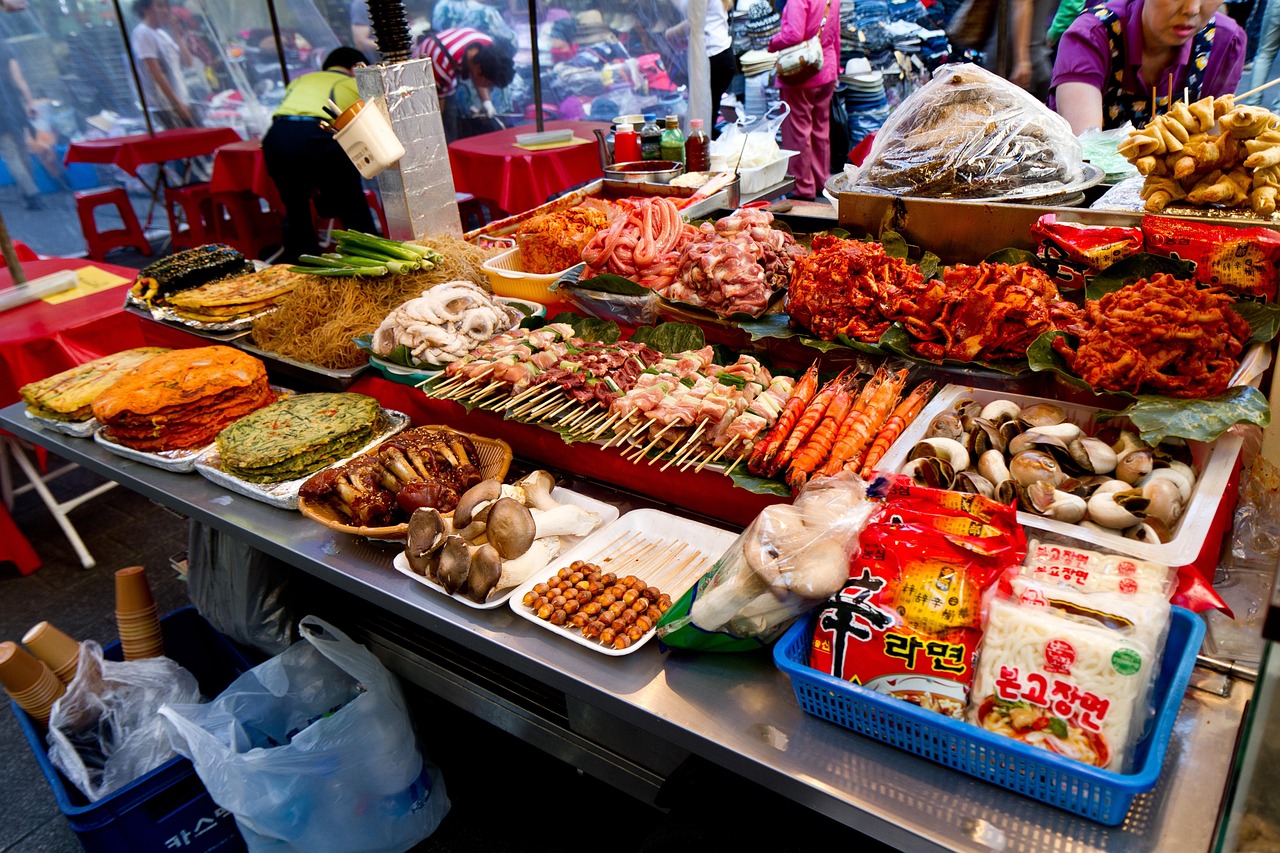
Gwangjang Market has been operating continuously in Jongno since 1905, which makes it the oldest surviving traditional market in Korea. That longevity matters because Gwangjang is not a staged food experience built for tourism — it is a working market where the same families have been operating the same stalls for generations, where the prices reflect competition with the stall next door rather than foot traffic from tour groups, and where the food is straightforwardly excellent in a way that comes from decades of iteration rather than curation. The fact that it now appears in Netflix documentaries and international food guides has not fundamentally changed what Gwangjang is.
The Three Dishes Worth the Trip
Bindaetteok (빈대떡) is the defining Gwangjang dish: a thick, crispy mung bean pancake fried in lard on a flat griddle until the edges are dark and the interior is soft and faintly earthy. A single serving runs approximately ₩5,000–8,000 as of 2026 — verify current pricing with your vendor. The best-known stalls are in the bindaetteok row in the covered interior of the market; you will find them by smell before you find them by sight. Order one, stand at the counter, eat it while it is still hot. This is one of the foods that rewards eating immediately and suffers from sitting.
Yukhoe (육회) is Korean beef tartare — finely sliced raw beef marinated in sesame oil, garlic, soy, pear juice, and pine nuts, served over thin rice noodles or alone with egg yolk on top. It is a Gwangjang speciality, available at multiple stalls in the interior. A serving runs approximately ₩12,000–18,000 as of 2026. The combination of yukhoe and bibimbap at a single stall makes a full meal. Yukhoe looks raw because it is — if you have health concerns about raw beef, skip it. If not, it is one of the dishes that makes Gwangjang worth the trip on its own.
Mayak gimbap (마약 김밥) — “narcotic rice rolls” — are small, tight gimbap rolls filled with pickled radish, carrot, and spinach, served with a mustard-soy dipping sauce. The name refers to the addictive quality rather than the contents. At Gwangjang they cost approximately ₩3,000–4,000 per serving as of 2026, and the stalls that sell them tend to have permanent queues during peak hours. They are lighter than the other dishes and make a good starter or snack before committing to something more substantial. Buy two portions — one is not enough.
Navigating the Market: Layout and Timing
Gwangjang has two distinct characters depending on when you arrive. During the day (9:00 AM–5:00 PM), it functions primarily as a wholesale fabric and textiles market — the largest in Korea — with the food stalls operating as a secondary draw in the covered interior. The evenings shift the balance: after 5:00 PM the food stalls dominate, vendors extend into the alleys, and the atmosphere is louder and more social. The food alley runs until approximately 11:00 PM, though stalls start packing around 9:30 PM.
The covered food hall is accessed through the main street entrance on the north side of the market (between Jongno 4-ga and 5-ga). The bindaetteok vendors are in the centre and west sections; the yukhoe and gimbap stalls are spread more broadly. Navigation is straightforward — the market is not large — but it is dense enough that walking the full interior before sitting down is worthwhile to compare stall activity and freshness before committing.
Getting there: Take subway Line 1 or Line 5 to Jongno 5-ga Station, Exit 8. The market entrance is immediately visible from the exit. Alternative: from Hongik University Station, it is approximately 25 minutes by subway via Line 2 to Euljiro 4-ga, then Line 5. T-money card works for all fare calculations.
2026 Update: QR Complaint System and Shop Registration
From June 1, 2026, Gwangjang Market introduced a real-name shop registration system for all food stalls, paired with a QR code at each stall that foreign visitors can use to submit complaints directly to market administration. This is a consumer protection measure aimed at reducing overcharging of tourists and inconsistent portion sizes — problems that have been documented at markets across Seoul as tourist volumes increased. In practice: prices are now displayed more consistently, and the QR mechanism gives you a formal channel if a stall charges significantly more than the posted price. Check the displayed menu boards before ordering and compare with the prices in this guide as a baseline. Prices naturally drift over time, so verify when you visit.
Budget and Practical Notes
A realistic per-person budget for a thorough food tour at Gwangjang — one bindaetteok, a yukhoe serving, a gimbap portion, and a drink — runs approximately ₩20,000–25,000 as of 2026. Two people sharing dishes can eat comprehensively for ₩35,000–40,000 total. This is meaningfully more affordable than a mid-range restaurant in the Myeongdong or Hongdae tourist zones.
Most Gwangjang stalls still operate primarily on cash, though some accept cards and the newer payment terminals support T-money. Bring Korean won in cash to avoid friction at peak hours. The stalls with the most apparent activity and fastest turnover of ingredients tend to be the most reliable for freshness — avoid stalls that look empty or have dishes sitting uncovered at ambient temperature.
Gwangjang pairs naturally with Insadong (10 minutes on foot to the west) and the Jongno palace district, making it a logical morning-to-lunch combination. For a broader food context across Seoul neighbourhoods, the Seoul overview guide covers dining by area. The market’s position in central Jongno also makes it easily accessible from Bukchon Hanok Village — see the Bukchon guide for the neighbouring district.
What should I eat at Gwangjang Market?
The three essential dishes are bindaetteok (mung bean pancakes, ₩5,000–8,000), yukhoe (raw beef tartare, ₩12,000–18,000), and mayak gimbap (small rice rolls with dipping sauce, ₩3,000–4,000) — all prices as of 2026, verify when you visit. Order bindaetteok and gimbap immediately on arrival and eat while hot. Yukhoe with bibimbap makes a full meal. A complete Gwangjang food tour covering all three costs approximately ₩20,000–25,000 per person.
What time does Gwangjang Market food alley open and close?
The food stalls inside Gwangjang Market operate from approximately 9:00 AM to 11:00 PM daily. The market itself opens at 9:00 AM. Peak food hours are 12:00–14:00 (lunch) and 17:00–21:00 (evening). Arriving after 9:30 PM risks the most popular stalls running out of ingredients. The textile and wholesale sections keep slightly different hours and close earlier in the evening.
How do I get to Gwangjang Market by subway?
Take subway Line 1 or Line 5 to Jongno 5-ga Station and use Exit 8 — the market entrance is visible from the exit. The journey from Hongdae takes approximately 25 minutes (Line 2 to Euljiro 4-ga, transfer to Line 5). From Gyeongbokgung, take Line 3 to Anguk and walk east approximately 15 minutes, or take a short taxi for ₩5,000–7,000. Use a T-money card for all subway fares.
Is Gwangjang Market safe for solo travellers?
Yes. Gwangjang is busy, well-lit, and staffed throughout its operating hours. Solo travellers eat routinely at the counter seating attached to each stall — this is the normal way to eat at a market stall here. You will be seated next to strangers and that is completely expected. The 2026 QR code complaint mechanism provides an additional consumer protection layer. The market is located in central Jongno, a heavily transited area, and is safe to visit at any point during operating hours.