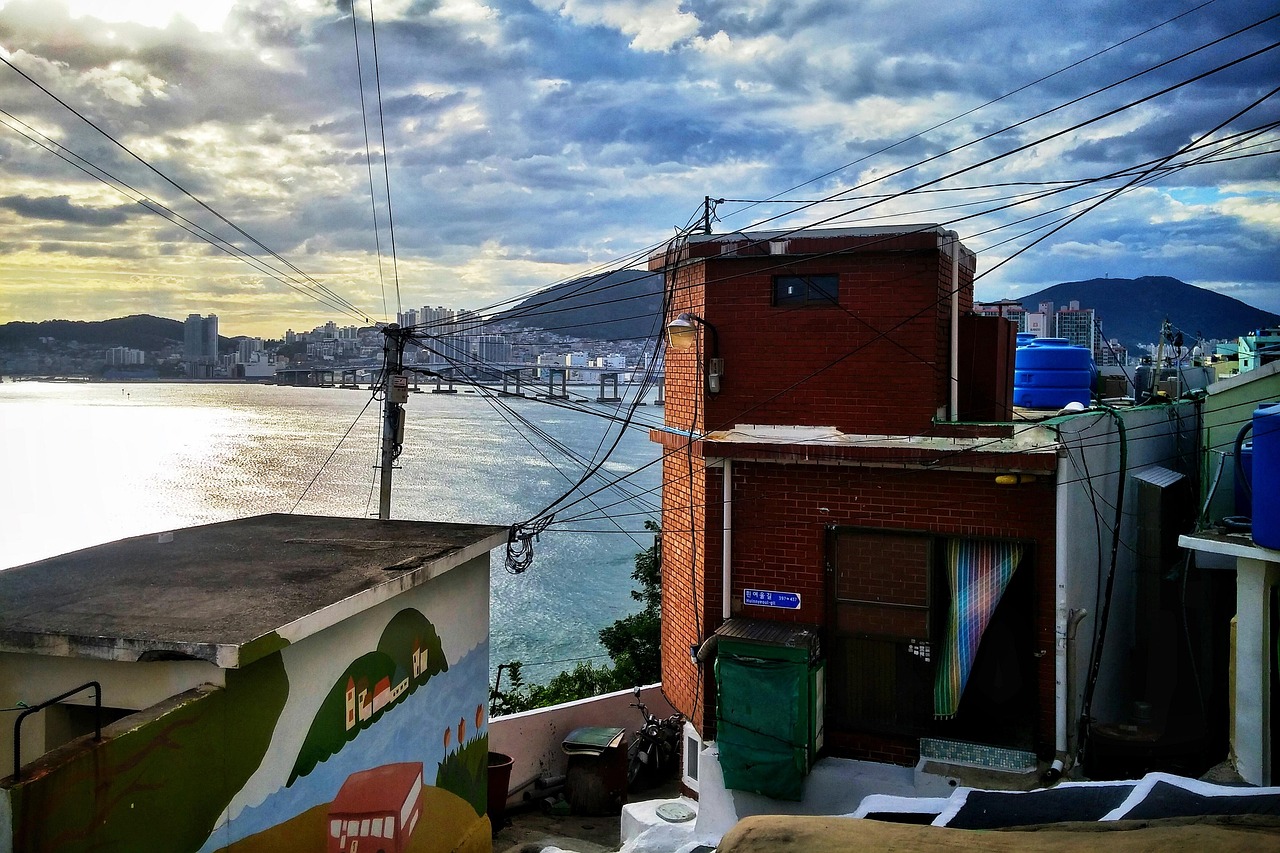
Every morning, a few hundred metres from the Busan Station concourse, a hillside of narrow lanes looks down on the port that once received tens of thousands of Korean War refugees. They built their homes on whatever slope was free, and the water had to be carried up from a well below, step by step. That climb is still there, and walking it is the most honest way to understand how modern Busan was made.
This guide covers Choryang Ibagu-gil, a short history trail on the slopes behind Busan Station in Dong-gu. It is not as photogenic as the pastel houses of Gamcheon Culture Village, and that is part of the appeal: fewer crowds, more real neighbourhood, and a story you can follow stop by stop. Details below are as of 2026 — verify on the official site before visiting.
What Ibagu-gil actually is
“Ibagu” means “story” in the Gyeongsang dialect, and the trail is Dong-gu’s way of preserving the district’s modern history: the post-liberation and Korean War refugee era, then the industrial decades of the 1970s and 1980s. The Dong-gu district office publishes an official course with nine spots, in this order: the Namseon Warehouse site and former Baekje Hospital, the Wall Gallery, the Choryang 168 Stairs Sky Road, the Myeongran Brand Research Center, the Ibagu Workshop, the Mangyang-ro Sanbokdoro Exhibition Hall, the Jang Gi-ryeo Memorial The Nanum Center, Ibagu Camp, and Yu Chi-hwan’s Postbox.
Sanbok-doro means “hillside road”, and the term matters. When refugees poured into Busan during the war, the flat land near the port was already full, so newcomers climbed. Shacks, then more permanent houses, spread up the mountain along paths that were never planned. Those paths became the lanes you walk today.
The route, step by step
Distances are quoted differently depending on the source. The official Dong-gu page lists the course at about 2.67 km and roughly 56 minutes, while press and tourism sources mention about 1.5 km. A fair way to hedge: expect roughly 1.5-2.7 km depending on how much of the loop you walk, and allow 1.5 to 2.5 hours if you stop at the museums and viewpoints. Times and distances can vary — check the official site before visiting.
- Start: Busan Station on Metro Line 1, Exit 7 is where the official course begins. Our Busan metro basics are in this Busan subway guide.
- Old downtown stretch: look for the former Baekje Hospital, whose building dates to 1922 and is described as Busan’s first modern hospital. It is a useful reminder that this was a port district long before the war.
- The climb: the Choryang 168 Stairs, a shortcut up to the hillside road. A 2026 travel report puts them roughly a 10-minute walk from the station.
- The upper lanes: the Myeongran Brand Research Center, the Ibagu Workshop and the Sanbokdoro Exhibition Hall, where the hillside story is told in more detail.
- Finish: the Jang Gi-ryeo memorial, Ibagu Camp and Yu Chi-hwan’s Postbox, then back down towards the station or onwards to Chinatown.
The 168 Stairs, and the lift that replaced the monorail
The stairs have exactly 168 steps and a steep gradient, roughly 35-40 degrees by Dong-gu’s description. During and after the war, residents and refugees used them to haul water from a well at the bottom to their homes at the top. From the upper platforms you look across Busan Port and the old downtown, and the view only makes sense once you have felt the climb.
Some older blogs tell you to ride the little red monorail up the stairs. Ignore them. That monorail opened in 2016, suffered repeated breakdowns, was judged unfit by the Korea Transportation Safety Authority in March 2023, and was demolished. Its replacement is a free 12-passenger inclined elevator called Choryang 168 Sky Road, which began operating in March 2025. It runs about 60 m, keeps the monorail’s red colour, and has three stops: the lower exhibition area near 168 The Deck, the midway Kim Min-bu Observatory, and the upper stop beside the Myeongran Brand Research Center.
No official page we found lists its operating hours, so treat any hours you read online as unconfirmed. Check the on-site signage, and expect it may pause for maintenance. The route and the stairs themselves are free and open year-round, as of 2026 — verify on the official site before visiting.
Kim Min-bu Observatory
The midpoint viewpoint honours the Dong-gu-born poet Kim Min-bu, who wrote the lyrics of the song “Waiting Heart”. His poem is inscribed on the wall, and the platform overlooks Busan Port and Busan Harbour Bridge. It is the best place to rest if you walk up rather than ride.
Who this walk suits, and who should skip it
This is a hillside walk, so be honest about your legs. If you can climb a few flights of stairs without difficulty, you will manage it. If you travel with a heavy suitcase, a pushchair or a wheelchair, the stairs are a poor fit, although the free lift covers the steepest part. The final approach is a steep uphill climb, so wear comfortable shoes with grip, not sandals.
- Suits: history lovers, photographers who prefer lived-in lanes, travellers with a spare two hours between trains.
- Suits less well: anyone expecting colourful photo-ready murals on every wall, or visitors with serious mobility limits.
- Compared with Gamcheon: Ibagu-gil is quieter, closer to the station and far less staged. For a wider view of the refugee story, add the UN Memorial Cemetery later in the day, or compare it with the island-side lanes in the Huinnyeoul Culture Village guide.
Pairing it with a Busan Station arrival day
The trail’s biggest advantage is location. If you arrive by high-speed rail, this is the easiest sightseeing you can do before check-in. Our Seoul to Busan KTX guide explains the fares and timings (all of which can change, so confirm on the official booking pages). Station lockers are the usual solution for bags, but availability and prices vary, so check on site.
A sensible plan: step off the train, leave your luggage, walk the trail in the morning, then finish at the Jang Gi-ryeo Memorial The Nanum Center. It honours Dr. Jang Gi-ryeo, often called “Korea’s Schweitzer” for caring for the poor and for helping pioneer medical insurance in Korea. Reported hours are Tuesday to Saturday 10:00-19:00 and Sunday 09:00-18:00, closed Mondays and public holidays. These come from a secondary listing, so confirm before you go; the centre is at 48 Yeongchou-wit-gil.
After the walk, you have two easy follow-ups. Cross the road to Busan Chinatown, also known as Shanghai Street, entered through the red Shanghai Gate. It is reached via Line 1 Exit 1 and is roughly a five-minute walk from the station plaza. The district traces back to a Qing consulate set up in Choryang in 1884, and the gate and street were created after the 1993 Busan-Shanghai sister-city agreement. Or carry on with the Busan one-day itinerary and head to Busan Tower and Yongdusan Park for the old-town skyline.
Practical tips from the ground
- Go early or late: the lanes are residential. Keep your voice down, do not photograph into windows, and respect any signs asking you to stay out of private areas.
- Climb up, ride down: or the reverse if your knees dislike descents. Using the lift for one direction is a sensible compromise.
- Bring water: shops on the hillside are limited, though the Ibagu Platform youth startup complex near the stairs has eight small shops, including cafes, a book cafe and a workshop. Opening times vary, so do not rely on them.
- Skip it in rain: wet stairs and lanes get slippery. Dates can shift for events and maintenance, so confirm on the official site.
- Budget: the walk is free. If you want cheap follow-ups, see our free things to do in Busan list.
Choryang Ibagu-gil will not give you the postcard shot, but it gives you the context that makes the rest of Busan richer. Give it a morning, and bring good shoes.
FAQ
Is the Choryang 168 Stairs monorail still running?
No. The old monorail was judged unfit in 2023 and removed. A free inclined elevator called Choryang 168 Sky Road replaced it in March 2025. Check on-site signage for operating status, as it may pause for maintenance.
How long does Choryang Ibagu-gil take?
The official Dong-gu course is listed at about 56 minutes of walking, but allow roughly 1.5 to 2.5 hours with stops. Distances range from about 1.5 to 2.7 km depending on how much of the loop you walk, as of 2026 — verify on the official site before visiting.
How do I get there from Busan Station?
Take Metro Line 1 to Busan Station and use Exit 7, where the official course begins. The 168 Stairs are roughly a 10-minute walk, with a steep final stretch, so wear comfortable shoes.
Is Ibagu-gil free?
Yes, the route and the stairs are free and open year-round, and the inclined elevator is free to use. Individual cafes and shops charge normal prices, which vary — confirm on site.
Is it suitable for children or older visitors?
Fit older children and adults manage it fine. The stairs are steep, so those with limited mobility may want to use the free lift for the steepest section or skip the upper lanes.