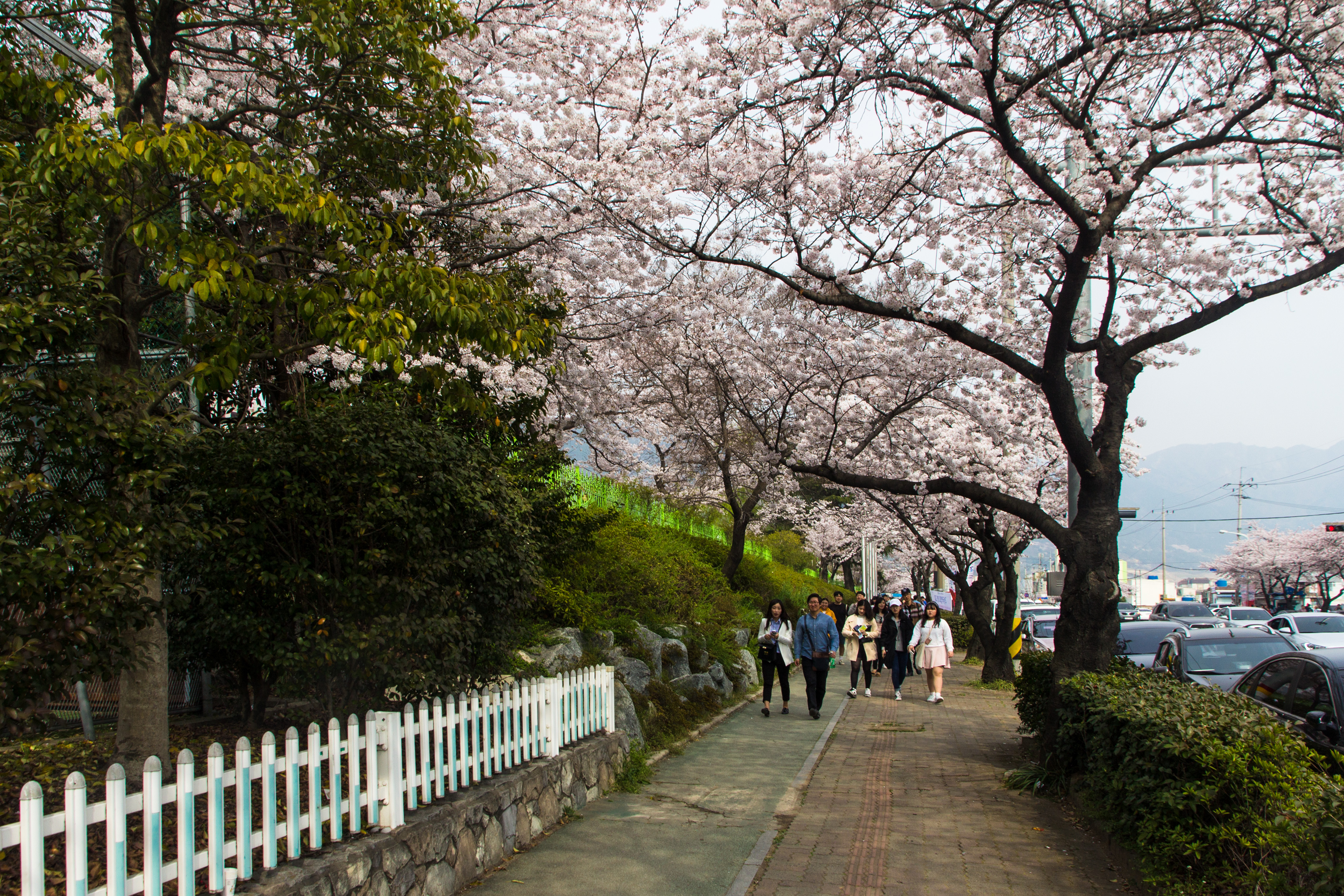
For roughly two weeks each spring, Busan trades its blue-grey winter for a wash of pale pink. Cherry blossoms – 벚꽃 (beotkkot) – open along the city’s streams, hillside roads and riverside parks, and because Busan sits on Korea’s warm southern coast, it is usually one of the first major cities in the country to bloom. Get the timing right and you can walk under tunnels of blossom before Seoul has even started.
This guide rounds up the best places to see cherry blossoms in and around Busan, with notes on how to reach each one and the all-important 2026 bloom timing. One reality check first: bloom forecasts shift every year, so treat the dates below as a planning window and confirm the live forecast closer to your trip.
When Busan’s cherry blossoms bloom (2026 timing)
For 2026, the cherry blossom forecast (published via Korea’s Weather-i service and echoed by the Korea Tourism Organization) puts Busan’s opening bloom around March 25, with peak bloom roughly one week later, near April 1. Blossoms this year are expected to arrive about two to seven days earlier than the long-term average, so the broad window to target is late March into the first week of April.
A few things shape exactly when each spot peaks. Coastal and low-lying areas – Gwangalli, Namcheon-dong and the riverside parks – tend to open first, while higher or shadier locations such as the slopes of Geumjeongsan around Beomeosa Temple usually lag a few days behind. Full bloom (만개, man-gae) typically lasts only about a week before the petals start to fall, so the margin for error is thin.
Important hedge: these forecasts are revised throughout March as the weather firms up, and an unusually warm or cold snap can move peak bloom by several days in either direction. Confirm the live bloom forecast in the week or two before you travel rather than booking flights around the dates above.
The best cherry blossom spots in Busan
Dalmaji Hill (Haeundae) – 달맞이고개
Dalmaji Hill (Dalmaji-gil, 달맞이길) is the postcard choice: a winding road climbing above Haeundae Beach, blossoms on one side and the open sea on the other. Locals nickname it Busan’s Montmartre for its cafes, galleries and slow, scenic switchbacks, and the combination of ocean and cherry blossom is genuinely hard to beat in the evenings. Walk up from the Mipo intersection at the eastern end of Haeundae Beach; take Busan Metro Line 2 to Haeundae Station and it is about a 15-20 minute walk to the foot of the hill.
Oncheoncheon Stream – 온천천
If you want the most relaxed, most local cherry blossom walk in Busan, this is it. Oncheoncheon is an urban stream through the Dongnae and Yeonje districts, lined for kilometres with cherry trees that reflect in the water by day and glow under streetlights by night. A dedicated cafe street (Oncheoncheon Cafe Street) lets you sit with a coffee under the canopy. Take Metro Line 1 to Oncheonjang or Dongnae Station and walk down to the streamside path, following it as far as your legs allow.
Samnak Ecological Park / Nakdong riverside – 삼락생태공원
Out on Busan’s western edge along the Nakdonggang (Nakdong River), Samnak Ecological Park turns into a sea of pink from late March into early April. More than 3,000 cherry trees line a long riverside trail, forming a tunnel of petals, and evening illumination makes it a favourite for couples. It sits within a broader belt of Nakdong riverside parks (nearby Maekdo Eco Park is quieter and stall-free), so there is plenty of room to spread out. It is a little further from the centre – take Metro Line 2 toward the Sasang area and continue by local bus or taxi.
Namcheon-dong cherry blossom road – 남천동 벚꽃길
This residential street near Gwangalli Beach is one of Busan’s most photogenic blossom tunnels – roughly 700 metres of cherry trees arching over the road around the Samik Beach Apartment complex. It is popular and can get busy, and because it is a live street with traffic, take care when stepping out for photos. Take Metro Line 2 to Namcheon Station or Geumnyeonsan Station; from there it is about a 12-15 minute walk, and you can easily pair it with a sunset at nearby Gwangalli.
Beomeosa Temple approach – 범어사
For something calmer, head up to Beomeosa, one of Busan’s great Buddhist temples, on the wooded slopes of Geumjeongsan. The approach and grounds come alive with cherry blossoms and spring colour, and because it sits higher up it often blooms a few days after the coast – useful as a late-season backup. Take Metro Line 1 to Beomeosa Station (Exit 5 or 7), then transfer to local bus 90 up to the temple, for a cooler, quieter mountain-temple feel far from the beach crowds.
A few more worth knowing
The road over Hwangnyeongsan (황령산) pairs cherry trees with sweeping city and night views; Dongdaesin-dong hides a quieter blossom tunnel; and Daejeo Eco Park sets cherry blossoms against Korea’s largest canola (yellow rapeseed) field for a pink-and-yellow contrast. All make good alternatives if the headline spots feel too crowded.
Day trip option: Jinhae Gunhangje
If you only do one cherry blossom thing near Busan, make it Jinhae. The Jinhae Gunhangje (진해군항제) in nearby Changwon is Korea’s biggest cherry blossom festival, built around an astonishing density of cherry trees that turn the whole district pink. The 64th edition is scheduled for March 27 to April 5, 2026. The signature sights are the blossom-lined Yeojwacheon Stream (여좌천) with its romance-bridge and the disused railway tracks at Gyeonghwa Station (경화역), both impossibly photogenic, plus performances and special viewing areas around the naval base and Jungwon Rotary during the festival.
Getting there is straightforward: from Busan Seobu (Sasang) Intercity Bus Terminal, take a bus toward Jinhae (roughly one hour), and seasonal day and night shuttle tours also run during the festival. As the country’s most popular cherry blossom event, it rewards a weekday visit – weekend crowds can be two to three times heavier. For a fuller plan, see our Jinhae day-trip guide linked below.
Tips for cherry blossom season in Busan
- Go early and on a weekday. Popular spots like Namcheon-dong, Dalmaji Hill and Jinhae fill up fast on spring weekends; mornings are quieter, cooler and far better for photos.
- Build in a buffer day. With peak bloom lasting only about a week, give yourself a flexible day or two rather than betting everything on one date.
- Keep a high-elevation backup. If the coastal spots have dropped their petals, the higher Beomeosa/Geumjeongsan area may still be blooming – and vice versa.
- Watch the weather. Rain and strong coastal wind strip blossoms quickly, so if a clear morning lands mid-bloom, prioritise it.
- Use the subway. Parking near these spots in peak season is miserable, and Busan’s metro reaches almost every location here.
Best time to visit
The sweet spot for Busan cherry blossoms is late March to the first week of April, with 2026’s opening bloom forecast around March 25 and peak near April 1. To fold in the Jinhae festival (March 27-April 5, 2026), aim at the overlap – roughly the last few days of March – and you can see the city’s blossoms and Korea’s biggest blossom festival on the same visit. Just remember the standing advice: confirm the live bloom forecast a week or two before you travel, because spring in Korea rarely runs exactly on schedule. For the broader national picture, see our guide to the best time to visit Korea, linked below.
Frequently Asked Questions
When exactly do cherry blossoms bloom in Busan?
For 2026, the forecast shows opening bloom around March 25 with peak bloom roughly one week later near April 1. However, forecasts shift based on weather, so confirm the live bloom forecast a week or two before your trip, as unusual warm or cold snaps can move peak bloom by several days.
How do I get to Dalmaji Hill and is it worth visiting?
Take Busan Metro Line 2 to Haeundae Station, then walk about 15–20 minutes to the foot of Dalmaji Hill from the Mipo intersection at the eastern end of Haeundae Beach. It's considered the postcard spot thanks to the combination of cherry blossoms on one side and ocean views on the other, plus local cafes and galleries.
What's the best spot for a relaxing walk among cherry blossoms?
Oncheoncheon Stream, an urban stream through Dongnae and Yeonje districts, offers a local favorite with kilometers of cherry trees that reflect in the water by day and glow under streetlights at night. You can even sit with coffee under the canopy at Oncheoncheon Cafe Street.
Should I visit the Jinhae festival, and how do I get there?
Jinhae Gunhangje (scheduled roughly March 27–April 5, 2026) is Korea's biggest cherry blossom festival with an astonishing density of blossoms. It's about one hour by bus from Busan Seobu (Sasang) Intercity Bus Terminal; weekday visits are much less crowded than weekends, which can draw two to three times more people.
What tips help me get the best experience during cherry blossom season?
Go early and on a weekday for quieter, better light and fewer crowds. Build in a flexible buffer day since peak bloom lasts only about a week. If coastal areas lose their petals, higher-elevation spots like Beomeosa Temple typically bloom a few days later. Use the subway to avoid parking headaches during peak season.