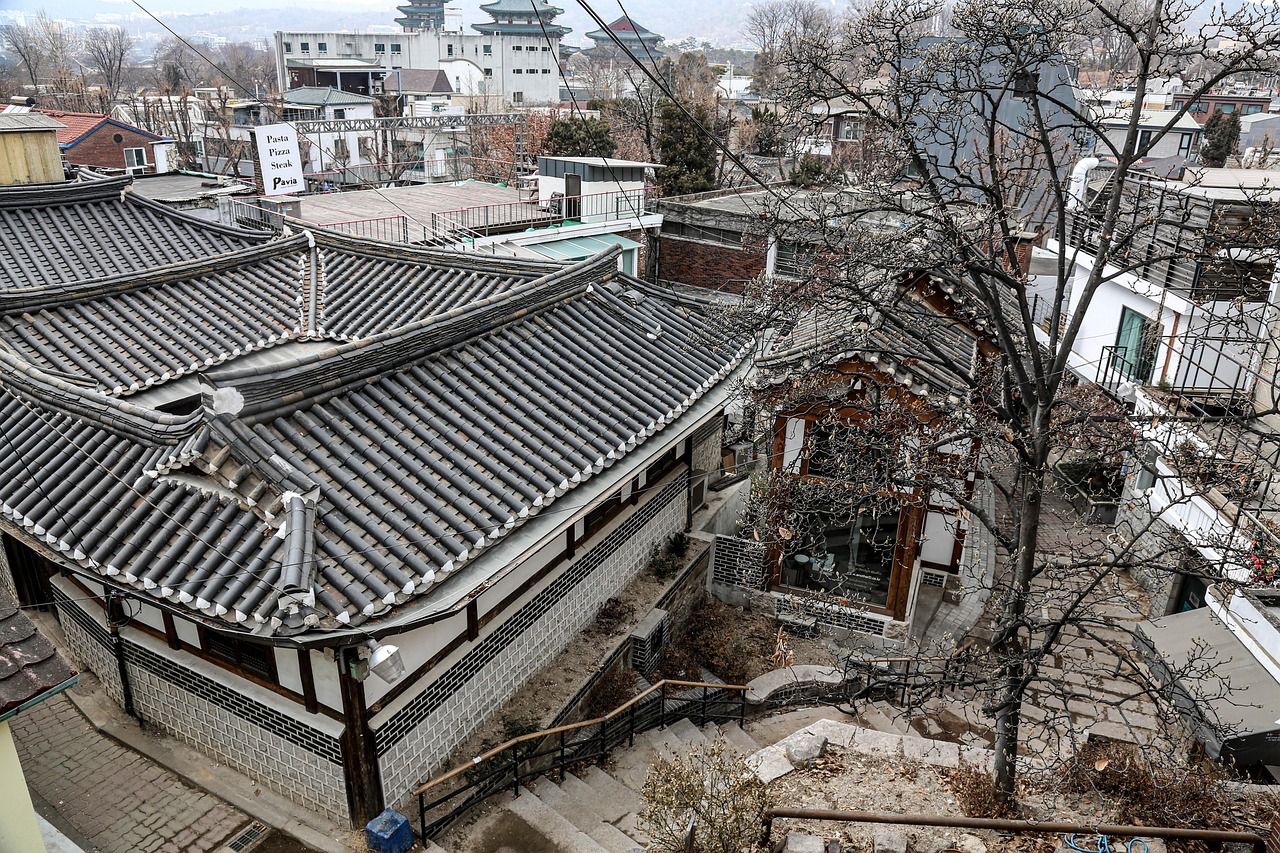
Seoul’s old city center holds three neighbourhoods that reward slow walking more than any highlight reel: Bukchon Hanok Village, Ikseon-dong alley, and the broader Jongno corridor that ties them together. Spend a full day here and you move through a thousand years of Korean history — Joseon-era timber rooflines, Japanese-colonial shopfronts, and postwar teahouses, all within a ten-minute walk of each other.
Bukchon Hanok Village: Walking the Eight Scenic Spots
Bukchon (북촌) sits between Gyeongbokgung and Changdeokgung palaces — both stops on a classic Seoul palaces walking route — on a hillside that was home to high-ranking Joseon officials for five centuries. Today roughly 900 private hanok remain, and the Seoul city government has mapped eight numbered viewpoints that form a natural walking circuit. Start at Bukchon Hanok Village Viewpoint 2 near Gahoe-dong — this is the steep alley photographed on every Korea travel blog, with curved grey tile roofs descending toward the city grid below.
The walk from the bottom of the hill near Anguk Station (Line 3, Exit 2) to the highest viewpoint takes about 40 minutes at a relaxed pace. Admission is free, but residents still live here, so the city posts quiet-hours signs: keep noise down before 10 am and after 5 pm. Some blocks request no photography of private gates — respect the signs. The best light for photos is 7–9 am on weekdays before tour groups arrive.
Along the way, stop at Bukchon Traditional Culture Center (free entry, closed Mondays) for a quick overview of hanok construction and a small craft demonstration area. For a hands-on experience, Bukchon Hanji Studio on Gyedong-gil offers 60-minute traditional paper-making classes for around ₩20,000 per person — book at least a day ahead online.
Ikseon-dong: Korea’s Most Atmospheric Alley
Five minutes downhill from Bukchon, Ikseon-dong (익선동) is a dense cluster of 1930s hanok that were subdivided during the Japanese colonial period into narrow row houses. Where Bukchon stayed residential, Ikseon-dong quietly converted into one of Seoul’s best-loved food and café districts without losing its bones. The lanes are barely wide enough for two people to pass, the buildings are low, and every third shopfront is a converted courtyard.
Practical eating guide for Ikseon-dong:
- Ikseon Ogane (익선오가네) — traditional Korean rice table (한정식 스타일 한 상) for around ₩15,000 per person. Expect 10–12 small side dishes, soup, and grilled fish. Cash preferred.
- Dongbinggo Patbingsu — a small dessert shop on the main alley serving shaved ice with red bean and rice cake from ₩9,000. Lines form after noon on weekends.
- Ikseon Makgeolli Bar — evenings only; traditional rice wine (막걸리) by the jug from ₩12,000 with pajeon (savory pancake) sides from ₩8,000.
- Several specialty coffee shops occupy courtyard hanok — look for ones with open wooden gates and original stone floors. Expect ₩6,000–8,000 for a latte.
Ikseon-dong is best visited on a weekday afternoon. Weekend afternoons can feel congested in the narrow lanes. The nearest subway stop is Jongno 3-ga Station (Lines 1, 3, 5), Exit 4, a two-minute walk.
Jongno: The Spine of Old Seoul
Jongno (종로, “Bell Road”) was the main commercial boulevard of the Joseon capital. Today it connects Gyeongbokgung in the west to Dongdaemun in the east, passing through Tapgol Park, the antique district of Insa-dong, and the temple of Jogyesa along the way. Even if you only have an hour, walk this corridor to feel the city’s layering — it fits naturally into a broader first three days in Seoul itinerary.
Key stops along Jongno, west to east:
- Jogyesa Temple (조계사) — the head temple of Korean Buddhism, free entry, open daily. The 500-year-old white pine tree in the courtyard is a Seoul monument. During the Lotus Lantern Festival (usually early May) the whole area fills with colour.
- Insa-dong (인사동) — a 700 m street lined with traditional craft shops, calligraphy suppliers, art galleries, and older teahouses. Ssamziegil (쌈지길) is an open-air mall inside a courtyard with local designer stalls; entry free, shops open from around 11 am.
- Tapgol Park (탑골공원) — site of the March 1st Independence Movement in 1919. The ten-storey marble pagoda inside (Wongaksa Pagoda, a National Treasure) dates to 1467. Admission ₩100 for adults.
- Gwangjang Market (광장시장) — a short detour north near Jongno 5-ga. This covered market has operated since 1905 and is famous for bindaetteok (mung bean pancakes, ₩4,000–5,000) and yukhoe (Korean steak tartare, from ₩12,000). Busiest at lunch.
Practical Tips for the Full-Day Route
The logical order is: arrive at Anguk Station by 8 am → Bukchon walking circuit (2 hours) → descend to Ikseon-dong for late breakfast or brunch → walk west on Jongno to Insa-dong and Jogyesa → Gwangjang Market for a late lunch → finish at Dongdaemun or head back via Jongno 3-ga. Total walking distance is roughly 6–8 km depending on detours.
- Transport: Anguk Station (Line 3) is the best entry point. Jongno 3-ga Station (Lines 1, 3, 5) sits in the middle. T-money card covers all subway trips; single fare ₩1,400.
- Shoes: Bukchon’s stone-paved slopes are uneven. Wear flat, comfortable shoes — heels are genuinely difficult here.
- Hanbok rental: Several shops near Anguk Station rent hanbok (Korean traditional dress) for ₩15,000–25,000 for a few hours. Wearing hanbok grants free entry to the four main palaces nearby.
- Best season: Spring (late March–May) and autumn (October–November) offer the most photogenic conditions. Summer is hot and humid; the area stays popular but bring water.
Should You Stay Overnight in a Bukchon Hanok Guesthouse?
Once the day-trip crowds clear out around 6 pm, Bukchon becomes a genuinely quiet residential neighbourhood again, and a small number of the surviving hanok operate as licensed guesthouses. Sleeping on a heated ondol floor mat inside a 100-year-old timber house is a different experience from walking through one at noon with a hundred other visitors, and it’s worth weighing against a standard hotel if you want more than a photo stop — see our guide to choosing where to stay in Seoul for a fuller comparison.
Who this suits: travellers who value atmosphere and quiet over convenience, and who don’t mind a shared or compact bathroom. Most Bukchon hanok guesthouses have only 3–6 rooms, thin walls by Western hotel standards, and steps or low door frames that are awkward with large suitcases or for anyone with mobility limits. Rooms typically run ₩90,000–180,000 a night as of 2026 — verify before booking, since small independent guesthouses change prices more often than chain hotels and don’t always update listing sites promptly. Who should choose a hotel instead: anyone prioritising elevators, 24-hour front desks, air conditioning control, or a late check-out — modern Jongno-gu hotels a 10–15 minute walk away (around Anguk or Jonggak) offer all of that for a comparable or lower price.
A local tip that doesn’t show up on booking-site listings: ask the guesthouse host directly (many respond on KakaoTalk or WhatsApp before you book) whether your room faces the alley or the inner courtyard. Alley-facing rooms catch early tour-group foot traffic noise from around 9 am; courtyard-facing rooms are noticeably quieter but sometimes get less natural light. If you book through a third-party platform you often can’t choose, so a direct message can get you reassigned to a better room at no extra cost.
If you’d rather not commit to a full night, several hanok in the Gyedong-gil area rent rooms for a few daytime hours as a “hanok stay experience” (roughly ₩40,000–60,000 for two hours as of 2026, prices can change) — a good middle ground if you want the interior experience without the noise trade-offs of overnight residential streets.
Rainy-Day and Evening Alternatives Nearby
Bukchon’s outdoor viewpoints and Jongno’s temple courtyards lose most of their appeal in heavy rain, and by around 6 pm in autumn and winter it’s already dark enough that the hillside alleys feel unfamiliar rather than atmospheric. Rather than pushing through bad weather, it’s worth having a short list of indoor or evening-friendly fallbacks within the same 10-minute walking radius.
- Seoul Museum of Craft Art — a free, purpose-built museum a short walk from Anguk Station showing contemporary Korean craft and design; a good rainy-morning substitute for the outdoor Bukchon walk, and rarely crowded compared to the alleys outside.
- Ikseon-dong’s covered arcades — several of the café courtyards have partial roofing, so Ikseon-dong stays more usable in light rain than Bukchon’s open hillside paths; this is the better rain-plan destination of the two.
- Jogyesa Temple’s covered halls — visitors are welcome to sit under the eaves during services even in poor weather, and the temple feels notably different — quieter, incense-lit — after dark than during the daytime tourist flow.
- Insa-dong’s indoor galleries and tea houses — traditional tea houses (다방) tucked off the main street stay open into the evening and are a comfortable way to wait out rain with a cup of omija tea (five-flavour berry tea, from around ₩8,000).
One detail worth knowing before you plan an evening visit: unlike Insa-dong and Jongno, which stay lit and active after dark, Bukchon’s residential lanes have minimal street lighting once shops close, and some of the numbered viewpoint alleys can feel genuinely isolated after around 8 pm. If your itinerary pushes into the evening, do the Bukchon leg first and save the better-lit, more commercial streets of Jongno and Insa-dong for after dark.
How do I get to Bukchon Hanok Village by subway?
Take Line 3 (Orange) to Anguk Station and use Exit 2. The entrance to the main Bukchon walking path (Gahoe-dong) is about a 10-minute walk uphill from the exit. Follow the brown tourist signboards.
Is there an admission fee for Bukchon Hanok Village?
No, walking through Bukchon is completely free. Individual cultural centres inside the village may charge small fees (usually under ₩5,000), but the streets and viewpoints themselves cost nothing.
What is Ikseon-dong known for?
Ikseon-dong is known for its narrow colonial-era hanok alleys converted into cafés, traditional restaurants, and small bars. It is popular for traditional Korean food, artisan coffee, and makgeolli (rice wine) in a historic atmosphere.
Can I visit Bukchon, Ikseon-dong, and Jongno in one day?
Yes, comfortably. Start early at Bukchon (8–10 am), move to Ikseon-dong for brunch (10 am–noon), then walk or take a short subway hop along Jongno in the afternoon. The full route is 6–8 km and takes around 6–7 hours including meals and stops.
What should I eat at Gwangjang Market?
The two signature dishes are bindaetteok (crispy mung bean pancakes, ₩4,000–5,000 per portion) and mayak gimbap (tiny seaweed rice rolls with mustard dipping sauce, ₩3,000). Both are sold at stalls in the central covered hall. Arrive before 1 pm on weekdays for shorter queues.