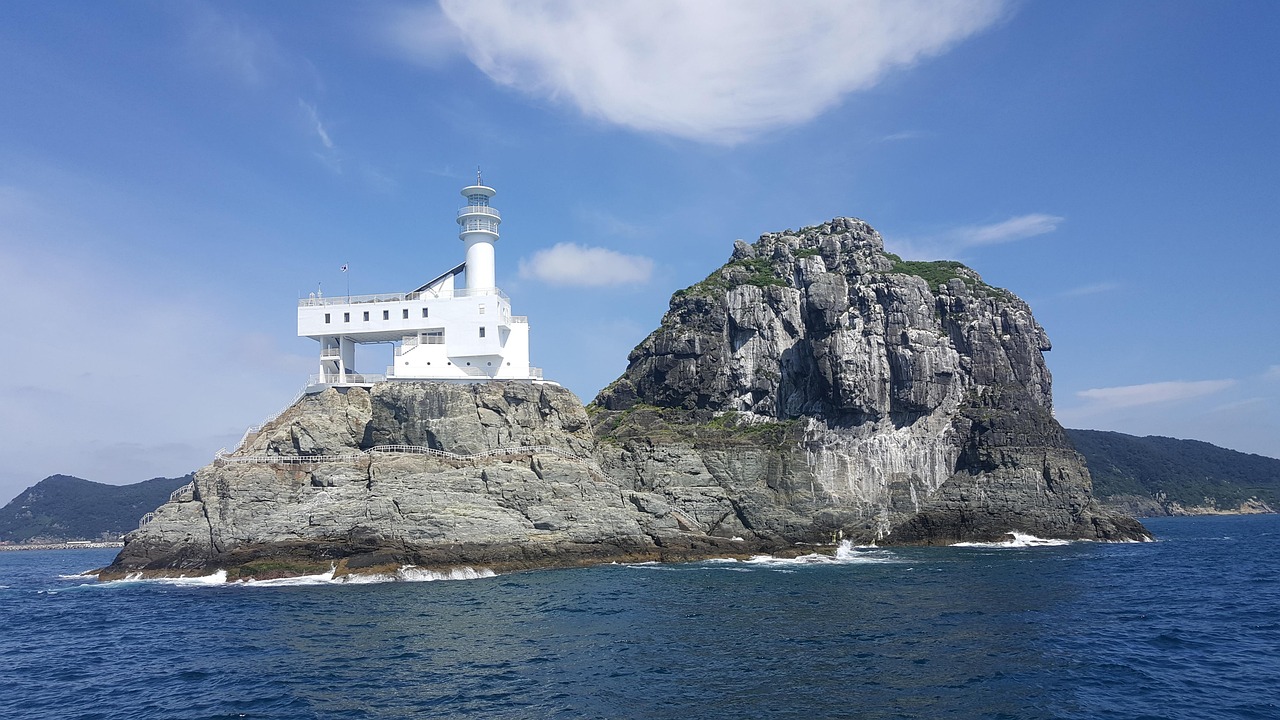
Tucked onto the western edge of Haeundae Beach, Dongbaek Island (동백섬, Dongbaekseom) is the green, forested headland that gives Busan one of its most rewarding free walks. Once a true island, it is now joined to the mainland, and a flat seaside boardwalk loops the whole shoreline past pine woods, a white lighthouse, a Silla-era scholar’s statue, and the unmistakable curves of Nurimaru APEC House (누리마루 APEC하우스) — the pavilion that hosted 21 world leaders at the 2005 APEC Summit. With Gwangan Bridge, the Marine City skyline, and Oryukdo all in view, it is part nature escape, part skyline panorama, and easy to fold into any Haeundae day.
How to get there
The simplest route is Busan Metro Line 2 to Dongbaek Station (동백역). Leave from Exit 1 and walk toward the sea — most visitors reach the island entrance in roughly 10 to 20 minutes (about 1.3 km), following the signs for Dongbaekseom and The Westin Josun Busan. Alternatively, if you are already at Haeundae Beach, just stroll to the beach’s western (far-right, facing the sea) end; the boardwalk continues directly onto the island, making it a natural extension of a beach walk. City buses 139, 307, and 1003 also stop near the entrance, and there is a paid public car park (Dongbaek Park) for drivers, though parking fills fast on weekends.
The coastal walk
The headline attraction is the seaside boardwalk loop, an easy circuit of roughly 900 metres to 1.2 km hugging the rocky coast on a raised wooden deck. It is largely flat, well-railed, and open 24 hours, free of charge, so you can walk it at sunrise, sunset, or after dark. A relaxed loop takes about 30 to 45 minutes; add time for photos and for the optional forest path that climbs gently through the pines to the upper viewpoints. Along the way you pass the lighthouse observatory, several viewing decks built out over the water, and the mermaid statue near the Westin, based on the local legend of Princess Hwangok. At the wooded high point sits the statue of Choi Chi-won (최치원, Choe Chiwon), a revered Silla-dynasty scholar; the name “Haeundae” itself is said to come from characters he carved on a rock here, drawn from his pen name Haeun.
Nurimaru APEC House
Perched on the island’s southern tip, Nurimaru APEC House is the architectural showpiece. The name fuses nuri (“world”) and maru (“summit”), and the three-storey building reinterprets a traditional Korean pavilion (jeongja), its roofline echoing the ridge of Dongbaek Island. Built for the 2005 APEC Summit, it still displays the leaders’ conference table, seating arrangement, and gifts from the event, with floor-to-ceiling windows framing Gwangan Bridge.
Admission is free. As of 2026, it generally opens around 09:00 and closes between 17:00 and 18:00 (last entry about an hour before closing) and is closed on the first Monday of each month. Posted hours and closure dates do shift seasonally, so confirm on the official Visit Busan site before a special trip. Note the building is a separate indoor venue — the surrounding boardwalk stays open even when Nurimaru is closed.
Views & photo spots
Dongbaek Island delivers some of Busan’s best skyline-meets-sea views in a single short walk:
- Gwangan Bridge & Gwangalli: The south-facing decks near Nurimaru give a clean, full-length sweep of the bridge arcing across the bay.
- Marine City skyline: The cluster of supertall towers rises directly across the water — especially striking at blue hour when the lights switch on.
- Oryukdo & the open sea: On clear days you can pick out the Oryukdo islets to the south, plus Mipo and Dalmaji Hill back toward Haeundae.
- The lighthouse: The small white lighthouse framed against the boardwalk and skyline is the island’s signature shot.
Best time to visit
Sunset is the standout window: the low sun lights up Marine City and Gwangan Bridge, and the bridge’s illuminations begin shortly after dark, turning the walk into one of the city’s finest free night views. For nature, come in late winter to spring (roughly December through March), when the island’s namesake camellias (dongbaek) bloom red across the headland. Early mornings are quietest and best for unobstructed photos; weekend afternoons are the busiest, as crowds spill over from Haeundae Beach.
Tips
- Pair it with Haeundae Beach. The boardwalk connects straight to the beach’s west end, so the two make an effortless half-day on foot.
- Accessibility: The coastal boardwalk is mostly flat and stroller- and wheelchair-friendly, but the inner forest path and some upper viewpoints involve stairs and slopes — stick to the seaside deck for a step-free loop.
- Bring water and sun cover. There is little shade on the open decks, and facilities on the loop are limited.
- Go at golden hour, stay for the lights. Arrive about an hour before sunset to catch both daylight skyline shots and the night illuminations on one visit.
Frequently Asked Questions
Dongbaek Island vs Oryukdo Skywalk: which coastal walk to choose
Busan has several free coastal walks, and first-time visitors often ask whether to prioritise Dongbaek Island or the Oryukdo Skywalk / Igidae coastal trail further south. They serve different purposes. Dongbaek Island is short, flat, and entirely paved — a 30 to 45 minute loop that suits travellers with limited time, families with a stroller, or anyone who wants a quick sunset walk right after the beach. The Oryukdo Skywalk and Igidae trail, by contrast, involve uneven rock paths, steeper sections, and a longer commitment of two hours or more; they reward hikers chasing dramatic cliffside views but are a poor fit if you are short on time or travelling with young children or mobility concerns. If you only have one evening in Haeundae, choose Dongbaek Island — it is close to the metro, free, lit for a night walk, and pairs naturally with dinner in the area. Save Oryukdo and Igidae for a day when you can dedicate a half-day specifically to a coastal hike, ideally combined with a taxi or bus back rather than the return walk.
A practical local tip that rarely appears in official tourism material: the benches and lower viewing deck directly below Nurimaru APEC House, on the side facing away from the main boardwalk crowd, are usually the quietest spot on the whole island for photos — most visitors stop at the upper decks near the lighthouse and never walk the extra two or three minutes down. If you visit around golden hour and want the Gwangan Bridge shot without other tourists in frame, head there first before joining the main loop.
On food and facilities: there are no restaurants or cafes actually on Dongbaek Island itself, so plan to eat before or after your walk. The Westin Josun Busan, right at the island’s entrance, has a hotel cafe and lounge open to non-guests, useful if you want a coffee with a sea view without leaving the immediate area — expect to pay hotel-level prices, roughly ₩8,000 to ₩15,000 for a coffee as of 2026, so verify current menu prices before visiting if budget matters. For a cheaper option, the cafes and convenience stores lining Haeundae Beach’s main strip, a five-to-ten-minute walk away, are far better value and let you grab a drink to carry onto the boardwalk. Public restrooms are available near the Dongbaek Station entrance and at a facility partway around the loop, but they can be basic, so it is worth using the ones at the Westin or a beachside cafe if you need something cleaner.
How do I get to Dongbaek Island from central Busan?
Take Busan Metro Line 2 to Dongbaek Station (Exit 1) and walk toward the sea—you'll reach the island in roughly 10 to 20 minutes following signs for Dongbaekseom. If you're already at Haeundae Beach, just walk to the western end and step directly onto the boardwalk; there's also paid parking at Dongbaek Park for drivers, though it fills quickly on weekends.
Is there an admission fee to walk the coastal boardwalk?
The seaside boardwalk loop is completely free and open 24 hours. Nurimaru APEC House itself also has free admission, though it typically opens around 09:00 and closes between 17:00 and 18:00—check the official Visit Busan site for seasonal variations and closure dates.
What's the best time to visit Dongbaek Island?
Sunset is the standout time, when the low light illuminates Marine City and Gwangan Bridge; the bridge's lights switch on after dark, creating one of Busan's best free night views. For blooming camellias (the island's namesake), visit late winter to spring (roughly December through March); early mornings are quietest for photos.
How long does it take to walk around the island?
The coastal boardwalk loop is roughly 900 metres to 1.2 km and takes about 30 to 45 minutes at a relaxed pace, though add time for photos and the optional forest path through the pines to upper viewpoints. The boardwalk is flat, well-railed, and mostly wheelchair-friendly.
What should I bring or know before visiting?
Bring water and sun protection, as there's little shade on the open decks and few facilities on the loop. The walk is easy to combine with Haeundae Beach (they connect directly), and arriving about an hour before sunset lets you capture both daylight skyline shots and the evening bridge illuminations in one visit.