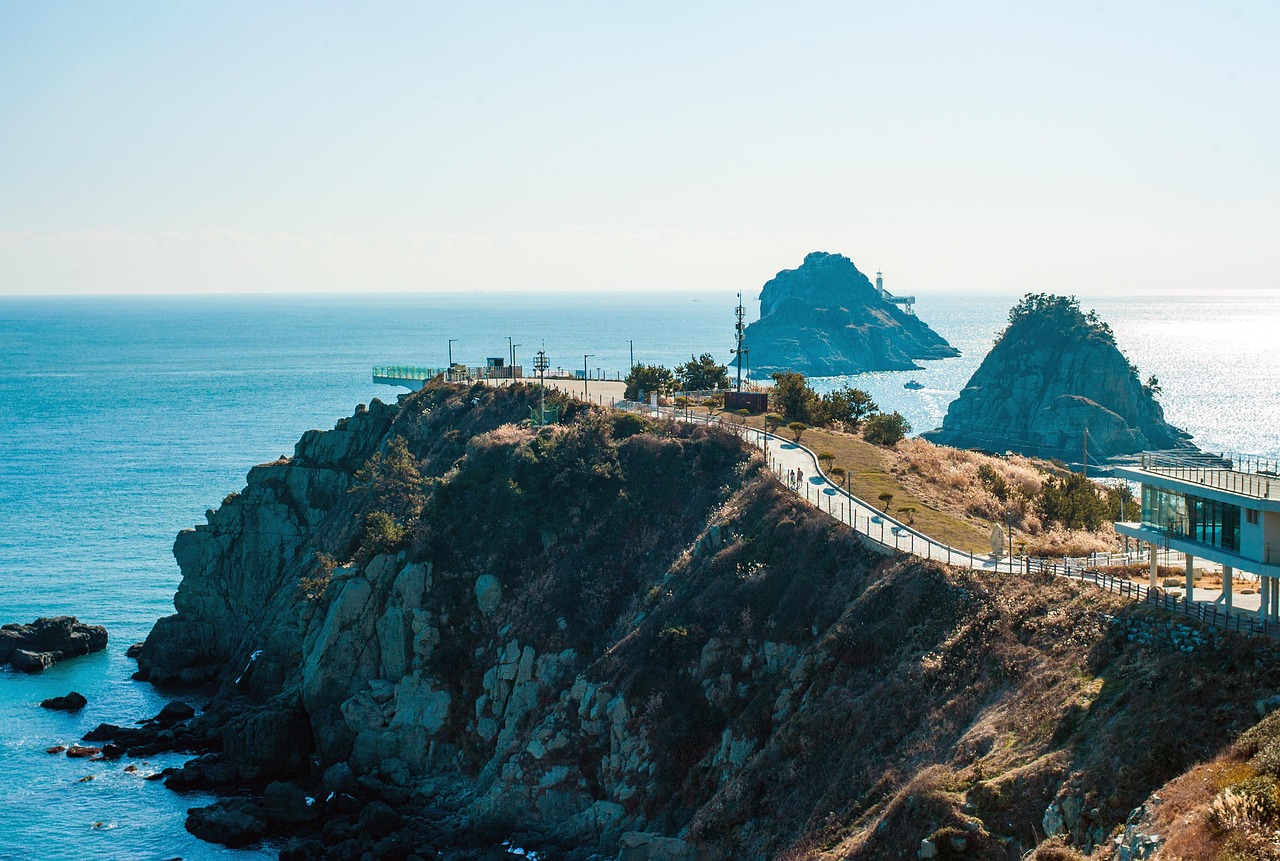
Busan (부산) is built on hills, sea-cliffs, and island headlands — which means the city practically hands you incredible views at every turn. Whether you want the vertigo-inducing thrill of a glass-floor skywalk over the ocean, a sweeping night panorama from a mountaintop observatory, or a leisurely coastal boardwalk perched above the waves, Busan has it. This guide covers every major skywalk and observation deck in the city, with practical directions, fee information (hedged where policies change), and the local tips that make each visit worthwhile.
Oryukdo Skywalk (오륙도 스카이워크) — Glass Floor Over the East Sea
The Oryukdo Skywalk (오륙도 스카이워크) is Busan’s most photographed walkway — a horseshoe-shaped, glass-floored platform that juts out from the cliffs at the southern tip of the city, directly above the East Sea. Standing on the transparent panels you can look straight down to the waves crashing on the rocks some 35 metres below, with the five-to-six Oryukdo islets (오륙도) floating offshore in front of you.
The view: On a clear day you can see all five (or six, depending on the tide — that is the famous riddle of their name) Oryukdo rocks, the open Korea Strait, and the curve of the Igidae coastline to the north. Sunrise and late-afternoon light are both exceptional.
Getting there: Take Busan Metro Line 2 to Gyeongseong University·Pukyong University station (경성대·부경대역), then bus 27 or 131 to the Oryukdo Skywalk stop, or a taxi from Haeundae or Gwangalli in roughly 15–25 minutes depending on traffic.
Cost & hours: Entry is free, though booties are provided (and required) to protect the glass. Hours vary by season — generally 09:00–18:00 with extended summer hours; check the Busan city tourism site before visiting as closures during strong winds are possible.
Tip: Pair the skywalk with the nearby Oryukdo–Igidae Coastal Walk (오륙도 이기대 해안 산책로), one of the best free coastal trails in the city. The combined half-day outing is hard to beat.
Songdo Skywalk & Cloud Walkway (송도 구름산책로)
The Songdo Cloud Walkway (송도 구름산책로) is a 365-metre suspended pedestrian bridge that arcs out from the hillside above Songdo Beach (송도해수욕장), curling over the sea before looping back to shore. Part of the structure passes over an open-water section, giving the sensation of walking on air above the waves. The walkway is free to use and lit up at night.
The view: You look directly down Songdo’s crescent bay with the cable car gondolas gliding past and the cliffs of Amnam Park (암남공원) in the background. Sunset colours the whole scene gold and amber.
Getting there: Busan Metro Line 1 to Tosu station (토성역), then a 20-minute walk along the coast, or bus 26/30 to Songdo Beach. The walkway entrance is at the western end of the beach.
Cost: Free. The adjacent Songdo Marine Cable Car (송도 해상케이블카) charges a separate fare (check current pricing at the cable car booth — rates and cabin types change).
Tip: Read the full breakdown of the cable car, beach, and nearby sights in our Songdo Beach, Skywalk & Cable Car guide before you go.
Cheongsapo Daritdol Observatory (청사포 다릿돌 전망대)
Less famous than the big-name spots but arguably more charming, the Cheongsapo Daritdol Observatory (청사포 다릿돌 전망대) is a small glass-bottomed platform extending over the rocks at Cheongsapo fishing village (청사포). The name comes from the stepping-stone rock formations in the sea below.
The view: Unlike the industrial-scale skywalks, this one puts you at an intimate distance above the water — you can hear the waves, watch fishing boats return to the tiny harbour, and see the coastline stretch toward Haeundae to the north. The double railway bridges of the old Haewundae Blue Line overhead add a retro backdrop.
Getting there: Blueline Park’s beach train stops at Cheongsapo station (청사포역) — a scenic and fun way to arrive. Alternatively, bus 100 or 1003 from Haeundae Beach (해운대해수욕장) takes about 15 minutes.
Cost: The observatory itself is free. The Blueline Park beach train and sky capsule are ticketed separately.
Tip: Cheongsapo’s seafood restaurants cluster right behind the observatory. A bowl of haemul pajeon (해물파전, seafood pancake) while watching the sea is a genuine local ritual.
Busan Tower — Yongdusan Observatory (부산타워 / 용두산공원)
Standing 120 metres tall in the heart of old downtown, Busan Tower (부산타워) in Yongdusan Park (용두산공원) has been the city’s signature landmark since 1973. A 2021 renovation gave the observation deck floor-to-ceiling panoramic glass, a sky-bridge between viewing levels, and a far smarter café than before.
The view: You are looking west over Busan Harbour, Yeongdo Island (영도), Namhang Bridge, and the container terminals of one of the world’s busiest ports. The 360-degree deck also catches Gamcheon Culture Village (감천문화마을) to the southwest on clear days.
Getting there: Busan Metro Line 1 to Nampo station (남포역), Exit 7, then a short walk up through Yongdusan Park (the park escalators help).
Cost & hours: There is an admission fee for the tower observation deck; current rates and hours are posted at the entrance and on the official site — they are subject to seasonal adjustment. The park itself is free.
Tip: The tower at night is especially atmospheric, with the harbour lights and Yeongdo Bridge visible. Our detailed Busan Tower & Yongdusan Park guide covers the park’s highlights including the large floral clock (꽃시계) and the statue of Admiral Yi Sun-sin (이순신).
Hwangnyeongsan Observatory (황령산 전망대) — The Best Night View in Busan
Ask locals where to go for Busan’s best night panorama and most will say Hwangnyeongsan (황령산), the 427-metre peak that rises from the geographic centre of the city. From the summit observatory you have an unbroken 360-degree view of every major district: Haeundae skyscrapers to the east, Gwangalli Bridge and the sea to the south, Seomyeon’s commercial core in the middle, and the mountains to the north.
The view: At night the city becomes a carpet of light. The neon towers of Haeundae Marine City glow blue and white while Gwangalli Bridge pulses with colour-changing LEDs. It is genuinely one of the most spectacular urban panoramas in South Korea.
Getting there: The easiest route is taxi from Seomyeon or Gwangalli (15–20 minutes, budget roughly ₩8,000–₩15,000 depending on origin and traffic — verify current fares). Driving is also common; there is a car park near the summit. Hiking from Munjeon-dong (문전동) takes about 40 minutes on a well-marked trail.
Cost: Free. The observatory and surrounding area are public parkland.
Tip: Bring a jacket even in summer — the summit can be noticeably cooler than the city below. See our dedicated Hwangnyeongsan Observatory Night View guide for the best photo spots and timing.
Dadaepo Sunset Observation Deck (다대포 전망대)
At the far southwestern edge of Busan, Dadaepo Beach (다대포해수욕장) faces due west across the Nakdonggang Estuary — which means it catches the most dramatic sunsets in the city. The small observation platform above the beach gives you a front-row seat as the sun drops behind the mountains of South Gyeongnam Province.
The view: The estuary stretches wide and calm in the foreground while the sun paints the sky in layers of orange, red, and purple. The famous Dadaepo Sunset Fountain (다대포 꿈의 낙조분수), the world’s largest musical fountain, operates in the same area during the warmer months and adds to the spectacle.
Getting there: Busan Metro Line 1 to Dadaepo Beach station (다대포해수욕장역), then a short walk to the beach. The metro journey from downtown Seomyeon takes roughly 40 minutes.
Cost: Free. The fountain shows also have no admission charge, though performance schedules vary — check the Saha-gu district website for current fountain showtime information.
Tip: Combine with the nearby estuary eco-park for migratory bird watching in spring and autumn. Full sunset and fountain details are in our Dadaepo Beach Sunset & Fountain guide.
Practical Tips for Visiting Busan’s Skywalks
Best time to visit
Spring (March–May) and autumn (September–November) give the clearest skies and the most pleasant temperatures for outdoor observation decks. Summer is peak tourist season — arrive early at Oryukdo and Songdo to avoid queues. Night visits to Hwangnyeongsan and Busan Tower are rewarding year-round.
Wind closures
Glass-floor skywalks (especially Oryukdo) are closed when wind speeds exceed safe thresholds. Typhoon season (July–September) occasionally causes temporary shutdowns. Always confirm opening status on the day if conditions look unsettled.
Getting around
Busan’s subway connects Nampo (Busan Tower) and Dadaepo easily. Oryukdo and Songdo are best reached by bus or taxi. Hwangnyeongsan is quickest by taxi. The Top 10 Things to Do in Busan guide has a full orientation to help you plan your visit.
FAQ
The Oryukdo Skywalk (오륙도 스카이워크) is the most famous glass-floor skywalk in Busan, projecting over the East Sea cliffs at the city’s southern tip. The Cheongsapo Daritdol Observatory (청사포 다릿돌 전망대) also has a smaller glass-bottom platform above the rocks.
Most are free. Oryukdo Skywalk, Songdo Cloud Walkway, Cheongsapo Observatory, Hwangnyeongsan, and Dadaepo Beach platform are all free to access. Busan Tower (부산타워) charges an admission fee for the observation deck — check current rates at the entrance as prices can change.
Hwangnyeongsan Observatory (황령산 전망대) is widely regarded as the best spot for Busan’s night panorama, offering a 360-degree view of the entire city. Busan Tower provides an alternative that is easier to reach by subway and gives a great harbour-facing view at night.
Take Busan Metro Line 2 to Gyeongseong University·Pukyong University station (경성대·부경대역), then board bus 27 or 131 to the Oryukdo Skywalk stop. The total journey from central Busan typically takes 30–45 minutes depending on connections.
Yes — a popular combination is Oryukdo Skywalk in the morning (pair it with the Igidae coastal walk), Busan Tower in the afternoon for harbour views, and Hwangnyeongsan Observatory after dark for the night panorama. Songdo and Cheongsapo are better saved for a second outing since they lie in opposite directions.
Frequently Asked Questions
Which skywalk has the glass floor you can see through?
Oryukdo Skywalk is Busan's most famous for its glass-floored platform — you can look straight down 35 metres to the waves below. Entry is free, though you'll need to wear protective booties to keep the glass clean. Hours typically run 09:00–18:00 but vary by season, and it may close during strong winds, so check ahead before visiting.
How do I get to Oryukdo Skywalk from central Busan?
Take Busan Metro Line 2 to Gyeongseong University·Pukyong University station, then catch bus 27 or 131 to the Oryukdo Skywalk stop. Alternatively, a taxi from Haeundae or Gwangalli typically takes 15–25 minutes depending on traffic.
Are there free skywalks in Busan?
Yes — both Oryukdo Skywalk and Songdo Cloud Walkway offer free entry. Cheongsapo Daritdol Observatory is also free, though you'll pay separately if you want to ride the Blueline Park beach train or sky capsule to get there.
What's the best time of day to visit these skywalks?
Sunrise and late afternoon offer exceptional light at Oryukdo Skywalk, while sunset is stunning at Songdo Cloud Walkway, turning the bay gold and amber. Early morning or golden hour tend to be best for photography across all sites.
Is Oryukdo Skywalk worth visiting if I'm scared of heights?
The transparent glass floor is undeniably vertigo-inducing, so it may not be comfortable for those with a serious fear of heights. If you want Busan's views without the glass-floor intensity, Songdo Cloud Walkway or Cheongsapo's quieter platform offer stunning vistas in a more relaxed setting.