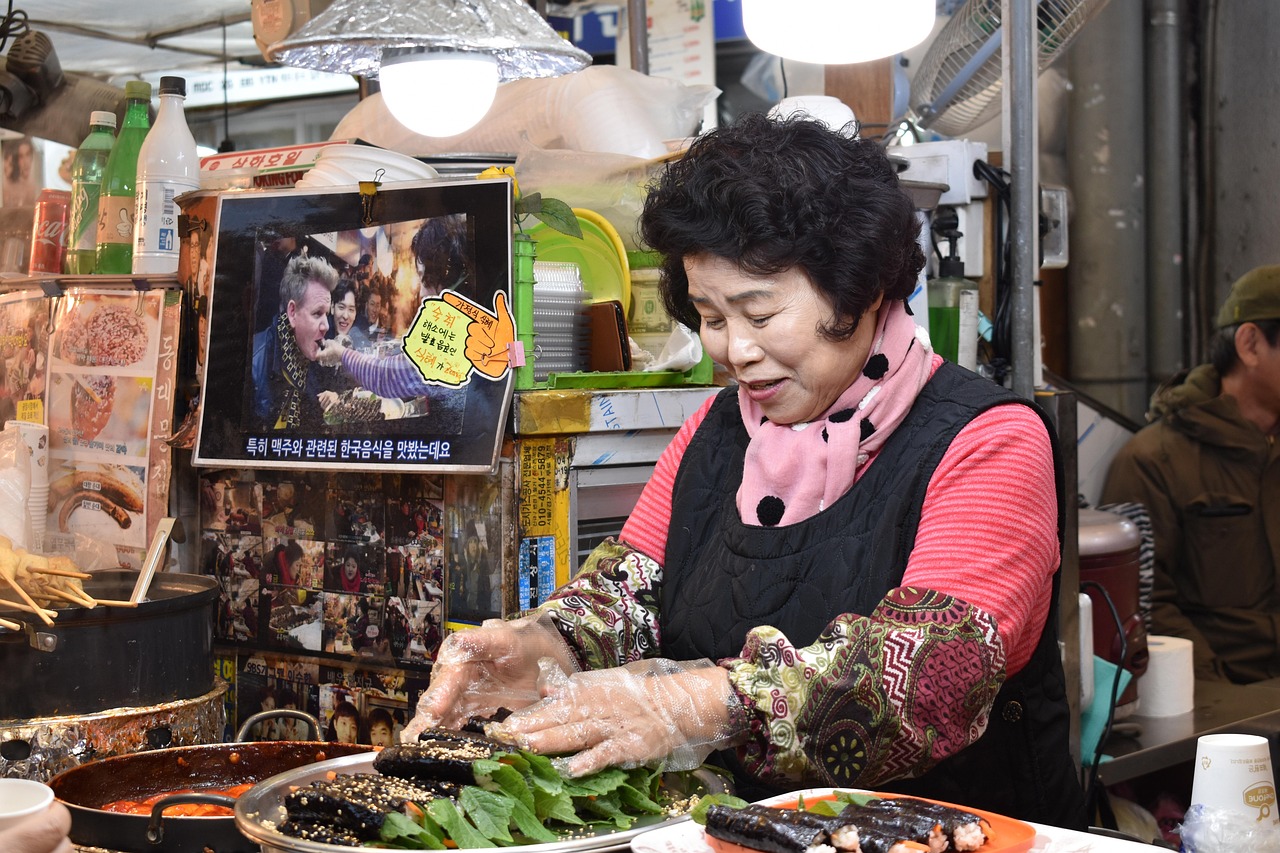
Hidden inside the hillside next to Gukje Market in Nampo-dong, Bupyeong Kkangtong Market (부평깡통시장) is Busan’s most atmospheric old market — a labyrinth of underground tunnels packed with vintage clothing, imported goods, canned food vendors, and a night market that runs until 04:00. It is one of the few places in Korea that genuinely looks the same as it did in the 1950s, and its night-market section is one of Busan’s best after-dark eating experiences.
Last updated: June 2026.
What is Bupyeong Kkangtong Market, and why is it called that?
Bupyeong Market (부평시장) is one of Korea’s oldest traditional markets, dating to the Japanese colonial period; the “Kkangtong” (깡통) section — meaning “tin can” — grew up after the Korean War, when black-market American military canned goods were sold here, a legacy still visible in the imported food stalls today. The underground arcade of covered tunnels (지하상가) was bored into the hillside in the 1960s and remains almost unchanged — low ceilings, small stalls, and a density of goods that overwhelms the senses in the best way.
What can I buy at Bupyeong Kkangtong Market?
The market splits into two very different zones: the daytime traditional market and the evening-into-night food market.
- Vintage & retro clothing — the underground arcade has dense clusters of stalls selling secondhand and vintage clothing, imported surplus, and streetwear at low prices (₩5,000–30,000 range). The best hunting ground in Busan for vintage finds.
- Imported canned & packaged food — a legacy of the Kkangtong era: foreign snacks, American-style products, global grocery items harder to find elsewhere.
- Hardware, household goods & fabric — the wider Bupyeong Market complex covers utilitarian goods serving the neighborhood.
- Night market food stalls — from around 17:00, food vendors set up along the main alley with tteokbokki, sundae, fried items, pajeon (savory pancakes), soondae-guk, and grilled seafood. Open until around 04:00 on weekends.
What should I eat at the Bupyeong night market?
The night market is busiest and most atmospheric from 20:00 onwards, when families and late-night eaters fill the narrow alleys. Look for:
- Tteokbokki (떡볶이) — spicy rice cakes in gochujang sauce, the classic Korean street food (~₩3,000–4,000).
- Soondae (순대) — Korean blood sausage stuffed with glass noodles; often sold as a platter with other offal (모둠순대, ~₩5,000–8,000).
- Haemul pajeon (해물파전) — large savory seafood pancake, best paired with makgeolli rice wine (~₩8,000–12,000).
- Twigim (튀김) — mixed deep-fried items: vegetables, shrimp, sweet potato, kimbap. Order by piece (~₩500–1,000 each).
- Gimbap (김밥) — rolled rice and filling, the Korean equivalent of a quick sandwich (~₩2,500–4,000).
When is the best time to visit?
Come in the afternoon to browse the underground market, then stay into the evening for the night market — 17:00–21:00 is the sweet spot when food stalls are fully set up and the alley is lively but not crushed. The market runs 7 days a week; some daytime stalls take Monday off.
| Zone | Hours | Best for |
|---|---|---|
| Underground tunnels (vintage/food) | ~10:00–22:00 daily | Daytime shopping, retro browsing |
| Night market food alley | ~17:00–04:00 (peak: 19:00–23:00) | Street food, late-night eating |
How do I get to Bupyeong Kkangtong Market?
Bupyeong Kkangtong Market is a 5-minute walk from Nampo Station on Metro Line 1 — the same area as Gukje Market and BIFF Square.
- Take Metro Line 1 → Nampo Station (남포역), Exit 7.
- Walk along Bupyeong-ro toward the hillside — the market entrance is unmissable, framed by stalls spilling onto the pavement.
- The underground tunnel entrance is set back slightly; look for the ramp going down into the arcade.
Tip: pair Bupyeong Kkangtong with Gukje International Market next door for a full Nampo market afternoon — together they form the largest traditional market complex in Busan. See the 3-day Busan itinerary for how to fit both into Day 2.
FAQ
Is Bupyeong Kkangtong Market tourist-friendly?
Yes, though it is a working local market rather than a curated attraction. Prices are set (not tourist-inflated), vendors are used to foreign visitors, and the night market food is easy to navigate by pointing and paying.
Can I pay by card?
Most food stalls and smaller vendors are cash-only. Bring ₩30,000–50,000 in cash for a comfortable evening of food and browsing; there is an ATM near the market entrance. Food and clothing prices throughout this guide are current as of 2026 and can change, so verify before you visit.
Is it the same as Gukje Market?
They are adjacent and connected, but distinct. Gukje Market is broader and brighter, covering clothing, household goods, and a more formal food court. Bupyeong Kkangtong is the narrower, more atmospheric underground section — darker, older, and with the best vintage stalls and late-night eating.
Is it worth going at night?
Strongly yes. The night market transforms the market into one of Busan’s most atmospheric after-dark experiences — warm light, steam from food stalls, Korean families and late-night eaters squeezed into narrow alleys. It is busiest from 20:00 to midnight and open until 04:00 on weekends.
Frequently Asked Questions
How do I bargain and shop the vintage stalls like a local?
Prices at the underground vintage stalls are more flexible than the fixed-price food stalls, but the room to negotiate is smaller than at a typical Southeast Asian night market — expect a 10–15% discount at most, not half off. Vendors here deal mostly with regular local customers and resellers, so aggressive haggling can come across as rude rather than savvy. The most effective approach is to buy two or three items from the same stall: bundling almost always earns a small discount without any awkward back-and-forth, and it is the method local shoppers actually use.
A practical local tip: many of the best vintage pieces are not on the racks at all — they are in unsorted boxes underneath or behind the counter, restocked from wholesale bales every few days. If a stall’s visible rack looks picked-over, it is worth asking “다른 것도 있어요? (da-reun geot-do i-sseo-yo?)” — “do you have others?” — and gesturing toward the boxes. Regular Busan vintage shoppers do exactly this, and it is rarely offered upfront to browsing tourists.
Cash is essential for negotiating — a vendor is far more likely to round down a ₩23,000 item to ₩20,000 if you are visibly holding cash than if you ask them to run a card first and negotiate after. Bring small notes; large ₩50,000 bills can make a vendor reluctant to discount since they cannot easily make change from a busy stall. Fitting rooms are rare to nonexistent in the underground arcade, so hold items up against yourself under the stall lighting rather than assuming a fit — returns and exchanges are not customary here.
Who this suits versus Seomyeon’s indoor vintage shops: Bupyeong Kkangtong is best for shoppers who enjoy digging through unsorted stock and don’t mind a dim, cramped, slightly chaotic hunt for a bargain — the reward is genuinely low prices and one-of-a-kind pieces. If you would rather browse curated, pre-selected vintage in a bright, air-conditioned shop at higher prices, the boutique vintage stores around Seomyeon or Jeonpo-dong’s cafe street are a better fit; they cost more but save the digging.
How do I get to Bupyeong Kkangtong Market from central Busan?
Take Metro Line 1 to Nampo Station and exit at Exit 7. It's a 5-minute walk from there toward the hillside in the Nampo-dong area. The market entrance is clearly visible with stalls spilling onto the pavement, and the underground tunnel entrance is marked by a ramp leading down into the arcade.
What time should I visit to experience the best night market atmosphere?
Aim for 17:00–21:00, when food stalls are fully set up and the atmosphere is lively but not overcrowded. The night market peaks between 19:00–23:00 and stays open until around 04:00 on weekends, so late-night visitors can find food and activity then too.
Is the market open every day, and what are typical opening hours?
Yes, Bupyeong Kkangtong Market is open 7 days a week. The underground tunnels typically operate around 10:00–22:00 daily, though some daytime stalls may close on Mondays. The night market food alley runs from around 17:00 onward. Check the official site or contact ahead for any holidays.
What are typical price ranges for clothing and food at the market?
Vintage and secondhand clothing typically ranges from around ₩5,000–30,000, making it the best vintage hunting ground in Busan. Night market street food is very affordable: tteokbokki runs about ₩3,000–4,000, soondae around ₩5,000–8,000, and seafood pajeon roughly ₩8,000–12,000. Prices can vary between vendors, so check before ordering.
Is Bupyeong Kkangtong Market worth visiting if I'm not interested in vintage clothing?
Absolutely—the night market food experience and historic atmosphere alone make it worthwhile. Even if vintage shopping isn't your thing, you can explore the unique 1960s underground arcade, sample authentic Korean street food, and experience one of Busan's most atmospheric after-dark eating scenes, especially when paired with nearby Gukje Market.
Explore more Korea Go Now guides
- The full Nampo market complex: Gukje Market & Nampo Night Market guide.
- What to eat in Busan beyond the markets: Busan food guide: 8 must-try dishes.
- Fit both markets into Day 2: the perfect 3-day Busan itinerary.